


Filed under: Cthulhu, fantasy, fiction, science fiction, Speculation, Uncategorized, Worldbuilding | Tags: Cthulhu, Interstellar Travel, Lovecraft revisionism, science fiction
Time for something different. Admittedly, it’s inspired in part by Matt Wedel’s recent musings on how to make a proper Cthulhu idol. Since it’s July, I figured I’d trot out something I’ve been musing about. It has to do with vernal pools. And Cthulhu. And interstellar civilization.
Vernal pools, in case you don’t know, are rain-fed pools that crop up in the spring. I’m used to the California ones, which feature a wide variety of (typically rare to endangered) species that act as typical aquatic or wetland species, but only for the few weeks to months that the pools last. They have a couple of neat properties that are relevant here. One is that vernal pool species have a number of ways of dealing with the inevitable death of the pool, from flying to another pool to going into hibernation to producing propagules (seeds, eggs, etc) that can survive up to a century before they grow once a new pool forms. The other thing to know is that organisms in the pool typically start at the small end (fairy shrimp, algae), followed by bigger ones (tadpoles, small aquatic plants), followed by “large” predators (dragonfly larvae, beetle larvae), followed finally by the really big things (ducks, garter snakes) as the pool dries. It all happens quite fast, a miniature serengeti, as someone called it.
If you don’t know what Cthulhu is, well, what can I say? Go read The Call of Cthulhu, and come back later. But this is more about Lovecraft’s whole mythos of critters that lived in deep time and still live here and there, ready to jump out and go boo. Erm… Right.
Lovecraft didn’t know much about math or biology, for which I don’t blame him. It wasn’t his thing. Still, rather a lot of science has floated under the bridge since he wrote in the 1920s and 1930s, so I’d suggest it’s high time to retcon the Cthulhu mythos into modern science. That, and it’s July. In that spirit, I’d like to suggest an interstellar civilization composed of Mythos monsters, and based in part on the model of a vernal pool.
Let’s start with our galaxy. By most measures, there seem to be millions of potentially habitable planets out there, but equally, in our world, we don’t see any evidence of interstellar cultures. This is slightly bizarre, as sun-like stars have been around from something like 500 million years longer than our sun has existed. One would guess that, if interstellar civilization could exist, it would exist, and that furthermore, it would have colonized Earth long ago. That is exactly what Lovecraft posited, with his fossil cities in At the Mountains of Madness, The Shadow Out of Time, and elsewhere. Personally, I think his reasons for why we’re not over-run by alien beasties are a bit weak, so this is where the retcon starts.
The big problem with interstellar civilization is that traveling between stars is horribly energy and resource expensive. Lovecraft got it right, when he talked about species migrating between the stars, rather than commuting (although his Outer Gods seem to not have that trouble). It follows then that when a interstellar civilization colonizes a planet, resource extraction begins in earnest. We’re not talking about sustainability here, not by a long shot.
Since we know what a non-sustainable civilization looks like (we’re living in one), we also know that, absent major changes, such civilizations die out in a geologic instant. This may sound non-functional, but there’s a way out of it. If the interstellar civilization on a particular world can colonize one or more new planets before the civilization dies, it can keep going. Planets recover from civilization over a 10-65 million year period (thanks to geologic processes that allow the biosphere to recover, new oil reserves that gather surplus sunlight, and erosion that uncovers ore deposits), so it’s theoretically possible for a really clever interstellar civilization to persist indefinitely by constantly moving, leaving most of the hundreds of millions of habitable worlds in the galaxy fallow for most of the time. When the civilization ends on a planet, its constituents either leave, die off, hibernate, or leave some sort of remnant or propagule to grow when civilization comes again, tens of millions of years later. Granted, it’s tricky for anything to survive intact for tens of millions of years, but with god-like technology comes god-like hibernation abilities.
So what happens when civilization rains down on a planet? I suspect it’s a lot like what happens when a vernal pool fills. The little guys (elder things and their shoggoth bionanotech) show up first and most frequently. If the planet’s biosphere isn’t that suitable, that may be all that shows up, and they leave after they’ve sucked up the available resources to move on to the next suitable planet. If conditions are more favorable, the elder things are followed by all manner of beings: mi-go, the Great Race, and so forth, each preying on (excuse me, establishing trade relations with) the things that came before.
Then Cthulhu and his kind show up. They’re the megacorps, excuse me, the big predators. However, Cthulhu has an odd biology. According to the Call of Cthulhu“[w]hen the stars were right, They could plunge from world to world through the sky; but when the stars were wrong, They could not live.” In biological terminology, Cthulhu and his ilk use two strategies: interstellar travel (“plunging through the sky”), presumably if the stars are close enough for them to make the transit, and they also can go dormant (“could not live”), presumably through some amazingly advanced form of anhydrobiosis, to wait between boughts of civilization. Once Cthulhu’s kind is through ravaging a planet, the show’s over, and those survivors who didn’t flee settle in to wait for the planet to heal itself. This is much like what happens when a vernal pool dries to mud. The flowers bloom in the mud, and everything sets up to wait through another dry summer
Note that colonization isn’t an organized process, but then again, vernal pool community formation isn’t organized either. Every pool is different every year, and it depends on things like how fast the pools are evaporating and what animals are close enough to colonize the pools. Most of them can pass a year (or hundred) without needing water. Similarly, interstellar civilization is conditioned by how far a particular species can travel between stars and by what they need to survive on a planet, whether they can pioneer an uncivilized ecosystem (as the elder things can), or whether they need a civilization present to feed their great bulk (as with Cthulhu).
When Lovecraft talked about ancient cities, his biggest problem was lack of a viable dating technology. He wrongly assumed that species had been on Earth for hundreds of millions of year due to fragments throughout the geologic record, when in fact the planet was settled repeatedly, at different times, tens or hundreds of millions of years apart. It’s an easy mistake to make.
We can even understand the nature of Lovecraft’s Other Gods in this scheme. Azathoth, the blind idiot god (or demon sultan) at the center of the universe is pretty clearly the black hole at the center of our galaxy. Without it, this galaxy wouldn’t exist, so it is our creator in its own mindless way. Yog-Sothoth, the All-in-One and One-in-All of limitless being and self, is probably our galaxy’s equivalent of the Internet, possibly powered in part by the central black hole Azathoth. After all, if civilized species don’t know what’s going on on other worlds, how can they know where to migrate next? Nyarlathotep, “that frightful soul and messenger of infinity’s Other Gods, the crawling chaos,” is Yog-Sothoth’s equivalent of Siri, or perhaps Clippy the Paperclip, which may explain humanity’s generally negative interactions with it.
This leads to some interesting ideas. Paleontology in Lovecraft’s world is likely to be rather more interesting than our world’s paleontology. Think of what the remnants of an alien interstellar city would look like in the fossil record. Moreover, there would be a rather more sinister explanation for Earth’s mass extinctions, and the evidence would be rather different.
Of course, the ultimate question for humans is, when the stars come right and galactic civilization comes to this planet yet again, do we join in the madness and plunge between the stars with them, do we resist, or do we hide out until they go away, and hope we can survive on the scraps left behind?
About a month ago, De. Deepak Chopra appeared on the NPR show Wait Wait Don’t Tell Me (which you can listen to at this link). At the end, he repeated the old idea that form is an illusion, because inside atoms is mostly empty space. While I have no quarrel with Dr. Chopra, I started thinking about this, and realized both that he is (most likely) dead wrong, but that form is nonetheless an illusion. Since I haven’t posted for a while, I figured I’d throw this up in the best (and increasingly endangered) tradition of late-night dorm bull sessions.
The issue with the Dr. Chopra’s idea can be boiled down to two words: dark matter. According to the physicists, a majority of the stuff in the universe is dark matter, which can be seen only by its gravitational signature. Assuming they’re right, all that “empty space” inside our atoms actually has a fair amount of stuff in it: dark matter, if not dark energy. Neutrinos sleet through a bunch of the rest of it, as do all the photons that convey the radio waves I was listening to. One could, in fact, argue that space is an illusion, that even the sparsest interstellar vacuum is far from empty.
But the mystics are still right: form is illusion. It’s just a different kind of illusion. For those who watch Brain Games on the National Geographic Channel. Human brains are not just prone to illusions, they are hard-wired to see them. Neuroscientists have been having a lot of fun studying the neuroscience of magic. The basic finding is that our brains use a number of systems and shortcuts to make sense of the world. Some of these are innate, while some are learned, often culturally specific. To over-simplify, the world is so complex that we cannot understand it without simplifying it, pinning meaning onto sights, sounds, scents, and so forth so that we can respond to raw sensory inputs and survive. Without meaning, we would be lost. For example, our eyes are somewhat less acute than average smart-phone cameras, but we see more because our eyes move constantly, and our brains stitch the images together to provide the illusion that we’re seeing more than we actually do.
Thing is, this is part of being human, and the downside is that we’re innately susceptible to illusions because of the way our brains process incoming data. It’s a tradeoff, honed by evolution: we see the stuff we need to see (in the evolutionary sense of needing to survive to leave behind offspring), but that means we can be fooled by everything from camouflaged snakes to clever illusionists. In this sense, forms are illusory. We don’t see only what’s there. Instead, our brains are grown to see what we find meaningful. This is the difference between a camera and an eye: a camera sees what is actually there. However, it takes an enormous amount of effort to program a computer to see with a camera, because the programmer has to figure out how to embody human norms, assumptions, and illusions as computer code to interpret the camera image in a way that makes sense to humans. We do it automatically.
Personally, I think that the idea that form is illusion should be thrown out. Anyone who aspires to enlightenment needs to realize that illusions are a fundamental property of the structure of their brains. Seeing illusions is part of being a human being. We can, however, learn to see things somewhat differently, to not be caught by some illusions. For some people overcoming some illusions may be important, whether it be spotting the rattlesnake in the dead leaves or not being bamboozled by a con artist. Unfortunately, we are limited beings, and we will never see the world as it truly is.
For a trifecta, let’s look at another common mystical statement, that now is the only moment that is real. This may be scientifically true: we don’t really know what time is, and the only moment we truly experience is now. Nonetheless, now is just as illusory as anything else. It takes something like 40 milliseconds for a sensation to travel from your toes to your brain, so your sense of what’s going on in your feet “right now” is actually 40 milliseconds behind. I have no idea how the brain integrates feelings so that you have the immensely useful illusion that your face and feet are feeling the same thing at the same time, or that sounds and sights are integrated with these feelings, but it’s all an illusion: your brain is busy compiling all this incoming data into one whole that is partially illusory. Your sense of yourself, what “you” are at any instant, contains a lot of illusion. It’s not at all a stretch to say (as the mystics do) that you are an illusion.
All this isn’t to bash Buddhism or any other mystical religion. While these religious ideas about space, form, and nowness may be partially illusory, Buddhism in particular is aimed at enlightenment, not as a way of winning some sort of psychosocial game, but as a way of overcoming suffering. Some scientific research suggest that, in fact, Buddhist practitioners can overcome suffering and become among the happiest people studied to date. From a scientific perspective, their practices may be based on illusions and a misunderstanding of science’s reality (and I can’t say this for a fact, since I’m not a Buddhist or a scholar of Buddhism), but if they can overcome normal human suffering, I’d say that Buddhists and other meditators are definitely worth our respect regardless.
Filed under: livable future, Real Science Content, Speculation, sustainability | Tags: Deep Future, livable future, science fiction, Speculation
I’ve been having some fun reading up on Milankovitch cycles since the previous post in this series, and I’ve learned that I didn’t know what I was talking about in the previous post. However, there’s still an apocalypse involved.
Here are the basics about global warming. The global average temperature goes up when there’s more CO2 in the air, down when CO2 goes out. The temperature change is proportional (roughly) to the doubling of CO2. If we double the old concentration of about 280 ppm, temperature goes up 1.5-5 degrees Celsius. If we quadruple it, the temperature goes up about 3-10 degrees, and so forth. Currently, we’re following what the IPCC calls the BAU (Business As Usual) model, or the 5000 Gigatonne carbon release. This will crank CO2 levels up to about 1200 ppm or more, so we’re easily into the quadruple jeopardy mode.
Anyway, the Milankovitch cycles are composed of three components: Earth’s orbital eccentricity, it’s axial tilt, and the precession of the orbit, all of which change at different rates. Of these three, only eccentricity (how elliptical the orbit is) actually changes the annual amount of sunlight earth as a whole receives, and that by only a percent or two. Obliquity and precession don’t affect the average amount of annual sunlight across the globe, and in this I was wrong.
Here’s the picture from the last post, about insolation at 65 degrees north at midsummer) for reference: 
What’s happening here is real, but it’s only true for the northern Arctic area. Variations at the equator are similar in direction but smaller in magnitude, while those at the Antarctic Circle are (very crudely) reversed.
Now, remember how I said that Earth wouldn’t be warming up at the peaks and valleys in this graph? That is true. However, there will be LOCAL increases and decreases in temperature. Variations in axial tilt and precession of the equinoxes cause substantial changes in the seasons. When there is a lot of sun in the north, the summers are warmer (and probably wetter), while the winters are cooler (and probably drier). At the local lows, the summers are cooler and drier, while the winters are warmer and wetter. This is all on a comparative level, of course: it’s the difference between, say, California and South Carolina. The California coast gets most of its rain and snow in the winter and has cool, foggy summers, while the Carolinas get most of their rain in the summer, and have relatively fewer rain or snow storms. The southern hemisphere, of course, follows the opposite pattern.
When we’re dealing with Ice Ages, cool summers and warm winters can be a problem. Warm winters mean more snow falls, while cool summers means the snow lasts longer. If the summers are cool enough, the snow never melts entirely, and glaciers start to form. If the summers are warm enough, the snow melts, and the glaciers go away. This is how (very crudely) Milankovitch cycles help control the onset and end of ice ages, at least during times when the climate is cold enough (due to low levels of CO2) that ice ages are possible. The northern hemisphere at 65 degrees north is a bit of a driver, because there’s more land at that latitude than there is in the southern hemisphere, and large ice fields help force global ice ages (more or less).
Now, getting back to the idea of 37 apocalypses. We’re dumping a lot of CO2 into the air, and it’s going to take a long time to come out. Therefore, the Earth will be warmer for a long time, until that carbon comes out of the air. However, the seasons can vary. Due to the Milankovitch cycles, the weather can vary between summer rain and winter rain. If the temperatures are tropical, this doesn’t particularly matter. Most tropical areas have a dry season and a wet season, but since the annual temperature doesn’t vary a huge amount, when the rain occurs doesn’t particularly matter. Milankovitch cycles don’t particularly matter.
However, closer to the poles, these matter, even if the world is very warm. Above the Arctic circle, there’s an entire season of darkness as the sun slips below the horizon (due to axial tilt). If most of the precipitation comes during the darkness, it will land as snow. If it comes during the daylit summer, it will come as rain. Different plants prefer these conditions, so people living there will have to grow different crops. To use the example of California and the Carolinas, California does great with winter vegetables and summer fruits, while the summer rain areas can grow things like corn and other late summer vegetables. Winter rainfall climates also tend to favor massive irrigation projects, because farmers have to capture the moisture that comes during the winter, and dole it out when the crops are growing.
The Milankovitch cycles do matter in that they dictate what the vegetation will be, due to when precipitation occurs and what form it comes in. Think the differences between Portland, Oregon and Madison, Wisconsin, for example . Plant communities will shift to follow the Milankovitch cycles, as will farming practices and things like irrigation. Classically, these are the kinds of shifts that cause civilizations to rise and fall, and I have no doubt this will continue into the future. As noted in the previous post, there will be times of future stability, and times of future change, and the times of change will likely bring down civilizations that adapted to the old conditions.
Considering how much I’m learning, I seriously doubt that this will be the last word on the subject, so if I don’t quite understand things now, feel free to straighten me out. My goal here is to think about what the deep future might look like, and I still think it looks like it’s going to keep changing for the foreseeable future, in ways that aren’t that favorable for stable, global civilizations.
I had a little bit of fun with the idea of future apocalypses to celebrate the non-apocalypse of 12/21/2012. Now that apocalypses are passe, I’d like to come back to the idea of environmentally induced apocalypses in the deep future. I’m nothing if not unfashionable.
One good place to look for such disasters is Wikipedia, specifically the article on Ice Ages, and even more specifically a little graph about halfway down, on daily insolation at the top of the atmosphere at 65 degrees north on the summer solstice. I’ve reproduced it below.
Now, I’m not a climatologist, but I’m not entirely ignorant, so I’ll attempt to explain this. Insolation is the amount of energy coming in at the top of the atmosphere. Sixty-five degrees north is pretty much the Arctic circle, and the summer solstice is the time of maximum sunlight. The general idea here is that times of low insolation coincide with ice ages, and the reason there is variation is due to orbital changes due to Milankovitch Cycles.
Now, this isn’t THE explanation of ice ages, because Milankovitch cycles have happened for the past 4.5 billion years. In most times, they don’t apparently result in Ice Ages. Occasionally they do. Other factors such as the position of the continents and the number and size of rapidly rising mountains (which take carbon out of the air through the silicon cycle) also matter. Beyond that, there are (of course) arguments about whether this is the most important value, or whether other factors are more important. Since we’ve got extremely complex models and imperfect climatological record, the arguments about the mechanisms behind ice ages are going to be argued for a very long time.
Despite that, let’s assume that the insolation graph is important, and that when the amount of energy coming in changes dramatically, the climate changes dramatically. Let’s also assume that a rapidly changing climate is generally bad for global civilizations like ours, and that inflection points are good for civilization, because the climate is stable at those points. The logic here is that a rapidly changing climate means that everything (plants, animals, and humans) has to move, because many formerly hospitable areas become less habitable, infrastructure breaks down, and so on. Conversely, stable global climates promote civilizations that create ways to take advantage of a climate that stays moderately stable for a few centuries, whether it is stably hot or stably cool.
In the above graph, between now and 400,000 CE, there are, by my count, 35 peaks and valleys. Each of these is somewhere between 500-1000 years long, which is about how long our civilization has expanded. Ditto with the Romans, come to that.
I’d suggest that we’ve got a very good candidate for our apocalypses here. The apocalypses are the slopes, where insolation changes substantially and keeps changing. At the start of each slope, a civilization that has lasted for centuries suddenly has to radically reinvent itself. In most cases, I’d suggest the result will be a dark age, likely an age of migrations. Sea level will fluctuate, deserts will become grasslands or vice versa, jungles will spread or contract, and so forth, and people will have to move. In my book, that’s an apocalypse for every culture ended by the crisis, although humanity will never be in danger of extinction.
I should point out that what we’re doing with our MegaBelch of gigatonnes of carbon will cause climate to change much faster than what we’re talking about here. If we really go for it and release 5000 GT of carbon in the next two centuries, it will take over 1000 years for sea level rise to max out (at about 100 m above current coastlines), although we’ll reach maximum temperatures in “only” a few centuries after the MegaBelch enters the atmosphere. This is really fast climate change, and while it will be slow in our lifetimes, It appears to be worse than anything on that insolation graph. Appears is the proper term, since I’m comparing the effects of carbon in the atmosphere to sunlight coming in, which is definitely comparing apples to orange groves.
Another caveat is that I’m ignoring all the black swans and most of the gray ones when it comes to future events. I haven’t factored in the megavolcanoes that are undoubtedly going to erupt during the next 400,000 years, nor am I factoring in city killing asteroids (we will get hit multiple times), and giant landslides like the East Kilauea rift, which will raise a gigantic tsunami when it inevitably slides into the Pacific. I can handwave this away by saying that such disasters are more damaging if they hit a globalized civilization, much less damaging if they hit in the middle of a dark age. As the WWII Siege of Stalingrad and the modern wars in Afghanistan have shown, once the infrastructure has been destroyed (which is relatively easy), it’s much harder to wipe out the people who are still living there. Pounding a city reduces it to rubble, but pounding a rubble pile just makes more rubble. On a humanitarian level this is horrendous (and it is not an excuse to keep from rebuilding Afghanistan or other failed states), but it is nonetheless true. A society that keeps its people comfortable is more fragile than one which has to endure disasters on a regular basis.
Regardless climate will continue gyrating into the deep future, however much carbon we blow into the air, and people will live through these changes. On the warm side, the global climate will most likely look like the late Paleocene or early Eocene. On the cooler side, it will look like the Pliocene, at least as long as there is surplus carbon in the air. After perhaps another 500,000 years, our carbon surplus will be gone and we’ll be back into the ice ages proper, with ice free poles in the interglacials and enormous glaciers during the intervening ice ages. Humans will survive, but I suspect our future on this planet is going to be a long history of lost high civilizations, fallow ages, and civilizations rising again during the times climates stabilize.
To put it simply, We Are Atlantis 1.0, and something like this is more likely to be our future than any singularity.
Filed under: Real Science Content, Speculation, Uncategorized | Tags: electrofishing, plesiosaurs, Speculative paleontology, Tanystropheus
I’m venturing back into the land of speculative paleontology with a modest suggestion about the reason why two groups of aquatic Mesozoic animals had ridiculously long necks. Some of these animals are very familiar: plesiosaurs. Some Plesiosaurs, members of the Plesiosauroidea, had ridiculously long necks. This trait was shared with the lesser known Triassic Tanystropheids, such as Tanystropheus longobardicus. Their necks are typically relatively stiff and weakly muscled, which gives rise to real questions about how the animal used them. Plesiosaurs, for example, could not raise their necks out of the water in the classic Loch Ness Monster or “swan” pose, nor could they sinuously retract their necks as if they were snakes’ bodies. Tanystropheus’ neck was even more limited, being compared to the stiff tails of hadrosaurs.
How did they use these necks? Proposals include Elasmosaurus “conceal[ing] itself below the school of fish. It then would have moved its head slowly and approached its prey from below” (from Wikipedia) to Tanystropheus fishing from marine shores as some sort of dipsy-diver, dropping its head down into the water from above. More bizarrely, taphonomic evidence in the form of fossilized sea floor gouges suggests that Plesiosaurids with long stiff necks were benthic feeders like rays or grey whales, grabbing their prey out of the mud (from Tet Zoo 2.0). It is hard to image an animal less adapted to such a hunting mode.
This doesn’t even get into the exquisite vulnerability of this body shape. Long, thin, stiff necks are very vulnerable to aquatic predators. Indeed, multiple artists have illustrated elasmosaur necks as the chew toys of large pliosaurs, and it is hard to imagine Tanystropheus surf fishing without getting its neck dislocated.
I’d like to suggest a different hypothesis, that these long, stiff necks were perfectly functional, and that, indeed, there are animals today that have similarly constrained morphologies. They aren’t tetrapods though, they’re fish. Electric fish, to be precise. Electrogenic organs have evolved at least four separate times in fish (Gymnotiformes, Mormyridae, Malapteruridae, Torpediniformes), and occur in both salt and freshwater. The South American knifefish (Gymnotiformes) are a particularly good example. As a group they have linear, fairly stiff, poorly muscled bodies. The apparent explanation for their shapes relates to the complexity of interpreting information from electric fields, and simpler body shapes make for more unambiguous signals. It appears that most electrogenic animals (animals that actively generate an electrical field for sensory purposes) have stiffer bodies with simpler shapes than do their less shocking relatives. This is also true for manmade electrogenic sensors, as a simple shape makes for a simple, easily interpretable field.
If the long stiff necks of Plesiosaurids and Tanystropheids are electrogenic organs, the weaknesses of the necks become strengths. Their necks’ main job is to be held stiff and straight in the water, and they appear well-built for this task. Moreover, electrogenic organs are built from stacks of electrocytes, which were the inspiration for batteries. The longer the neck, the more “batteries” it can hold, the bigger a field it can create, and the higher a voltage it can generate. The advantages don’t stop there. Electrogenic organs have three potential functions: sensing, electrofishing, and defense, and I will explore each in turn.
Active Electrolocation
Many animals can detect electrical fields, with or without special organs. Humans can detect sufficiently strong electric fields, while everything from catfish to sharks and rays to platypuses and river dolphins have structures specialized in passively detecting weak electrical fields. Electrogenic animals all actively use their electrical organs to sense their environments, feeling differences in the field due to the presence of things that either are either more or less conductive than the surrounding water. They can also detect the electrical fields innately given off by all animals through things like muscular exertion, heartbeats, or (in fish) the gill area. All of this adds up to a sophisticated electrolocation sense.
This is particularly important for animals that hunt in waters where vision is limited, either through turbidity or at night. It is also quite useful for hunting animals buried in the sediment, which is an explanation for the Jurassic sea-floor gouges caused by Plesiosaurids.
In an attempt to illustrate this, I chose the small (30 cm long) tanystropheid Tanytrachelos. This species was found in the Triassic, in the Solite Quarry in Virginia. It was apparently amphibious, for it was found in the sediments of a highly seasonal lake, and its webbed footprints are found fossilized in lake mud. Its main prey were apparently insects, and it apparently co-occurred with the fish Turseodus, of approximately the same size. Given the description of the lake sediments (alternating layers of mud and decayed vegetation), I suspect that the water wasn’t terribly clear, as it has been illustrated. The lake water may have been stained tea-brown by tannins, or it may have been muddied by rain and animal activity. Either way, I would suggest that Tanytrachelos was something like a platypus, an aquatic insectivore that found its prey using their electrical fields instead of eyesight.
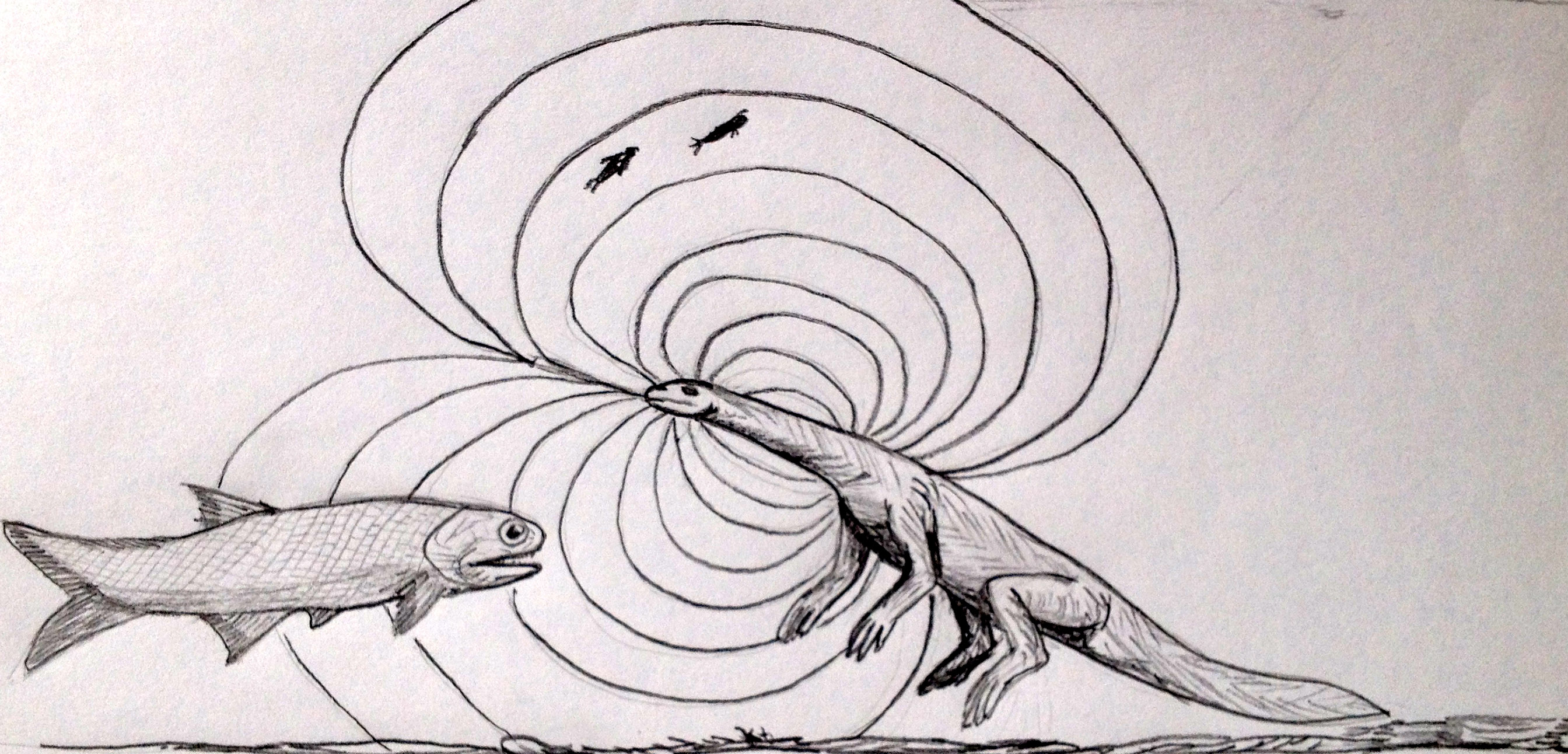
Cartoon of Tanytrachelos electrolocating a Turseodus in Solite Lake
I should note that all the long-necked species probably used electrolocation. It doesn’t take a large electric organ, and in turbid or dark environments it can be critical. It’s also possible that a majority of Plesiosaurids and Tanystropheids were electrolocators only. In modern electric fish, a majority are electrolocators, not active shockers, and there’s no reason to think this was different in the past. Certainly there is a tradeoff between carrying an electric organ and using a neck for something else, and there’s no reason to expect them all to be electrofishers. But some could have been.
Electrofishing
Here, I would like to compare the fish biologists’ standard sampling tool, electrofishing, with the biological versions. While it is not clear that electric eels hunt with their electric organs, marine torpedo rays certainly do. However, the best insight comes from human electrofishing. For those who are not familiar with it, electrofishing involves using a generator, a transformer, and at least two electrodes. When the system is properly tuned, fish are stunned and can be captured for population samples. Most electrofishing rigs work in freshwater, but several research groups practice marine electrofishing. Still, there are a number of complexities.
Human electrofishing works on a simple principle. Many fish, when caught in a pulsed DC field between a cathode and an anode, involuntarily swim towards the anode, a phenomenon called positive electrotaxis that is caused by involuntary muscle contractions in the fish. Fish biologists use this trick to draw fish into the anode area without killing them, so that they can count and measure them. Translating this to electrofishing animals, I propose that the animals used pulsed DC current, with the anode located immediately behind the head. If one looks at the field lines, this would cause fish to swim uncontrollably straight into the predator’s mouth. Additionally, electrofishing rigs are deliberately designed with the anodes as large as possible to avoid damaging the fish (reference). One could easily argue that the long, slender necks with small heads of animals like Elasmosaurus or Tanystropheus are the exact opposite, with small anodes evolved to stun, injure, or even kill the the prey before it reaches the predator’s mouth. I used Tanystropheus in the cartoon below to illustrate the principle, with the anode behind the animal’s head.
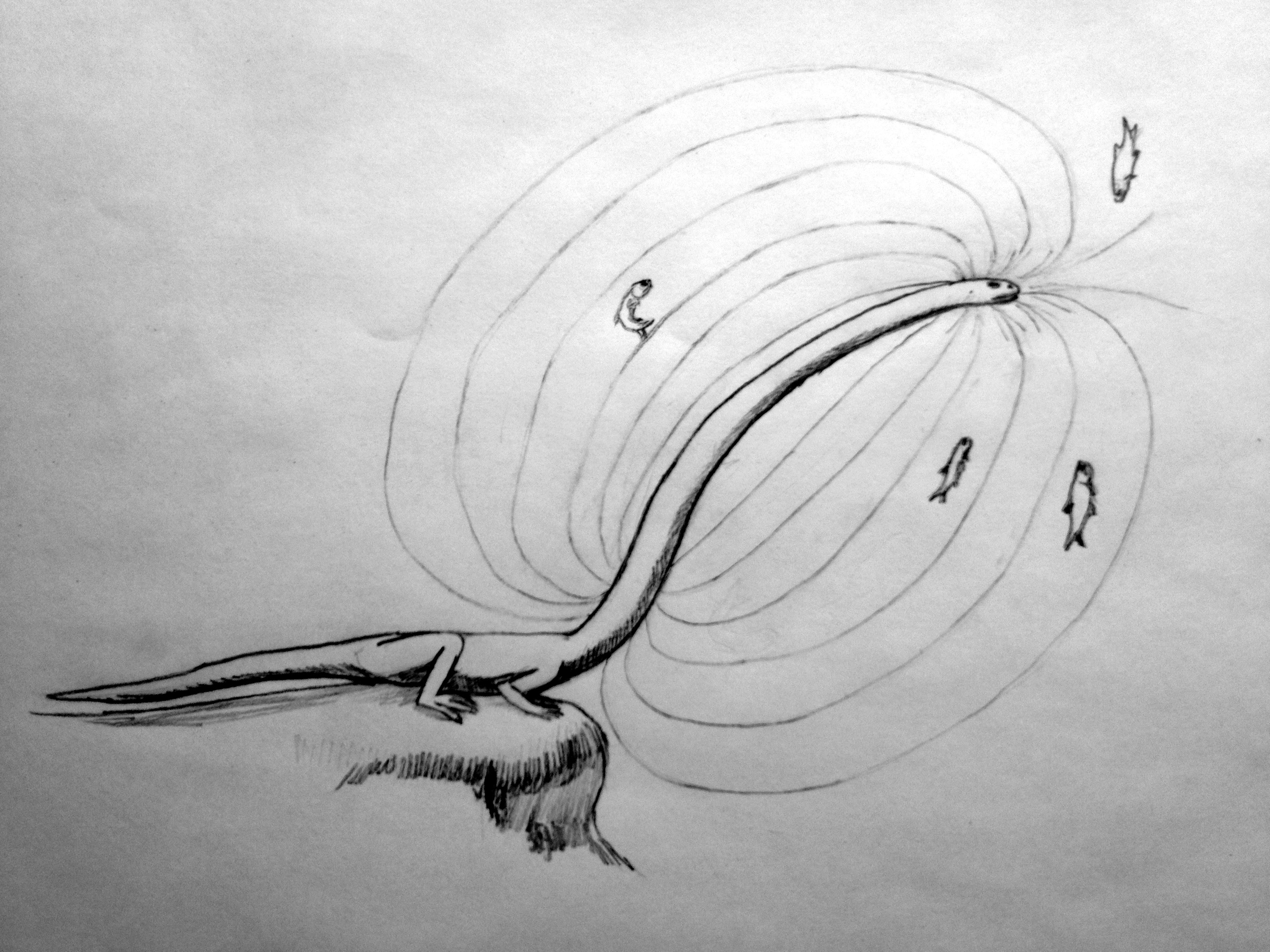
Tanystropheus electrofishing, with the anode behind the head.
While this is simple in theory, it becomes complex in practice. For one, seawater conductivity varies depending on temperature and salinity. For another, fish catchability varies depending on the ratio of conductivity between the fish and the water, with a maximum efficiency where the fish has the same conductivity as the water. There are other factors, such as the frequency of the pulsed DC current used, which varies by fish targeted (usually determined empirically by biologists), and factors such as the thickness of the fish scales (thick-scaled fish are harder to catch this way) and the size of the fish (larger fish are more vulnerable than smaller fish) (reference). As an aside, it is not clear whether electrofishing works on squid or insects, apparently due more to lack of experimentation than anything else.
Thus, there is no one optimal design for electrofishing animals. Plesiosaurids could not broadly harvest every fish in the water, but would be constrained by how they could adjust to factors like salinity and the fish present, and I suspect that the substantial diversity they show represents adaptations to different electrofishing strategies. Most likely, the biggest plesiosaurids would have to migrate frequently to avoid fishing out local habitats and to take advantage of spawning clusters or feeding congregations, much as large sharks do today. Since a proportionally bigger electrofishing rig is required for oceanic uses, it suggests that freshwater electrofishers should have proportionally shorter necks. This appears to parallel the fossil record, where known estuarine or freshwater species have shorter necks than do marine animals.
As an aside, I get the impression that Mesozoic fish had thick scales compared to those of today. While this may be erroneous, it is possible the Plesiosaurid electrofishing caused adaptive pressure on Mesozoic fish to favor thicker scales than we find today.
Why are there so few electrofishing modern animals? I would suggest that the answer is aerobic capacity. Electric eels reportedly get 80% of their oxygen from the surface. They are air-breathers, more than some amphibians, but torpedo rays (the other electrofishers) are not. While I’m not aware of any physiological studies, large electrical organs have to be metabolically expensive, and being air-breathing does make it easier to power them However, electric eels are stuck morphologically, because they have to cram their all their organs into a shape optimized for electrogenesis, and they have heavily vascularized oral cavities rather than true lungs. Air-breathing reptiles are not so constrained. Better still, their electrical array is physically separated in their necks, away from their heart, lungs, and swimming fins, allowing each system to work separately with fewer morphological constraints. As a result, they could grow much larger than electric eels or any modern electric animal. As for how Plesiosaurids avoided electrocuting themselves with their own voltage, all I can say is that electric eels somehow get away with it, so presumably it’s quite possible. Some electrolocating fish have encephalization quotients close to those of humans, so it’s unlikely that electrogenesis would be a problem for Plesiosaurid nervous systems.
Electrical Defense
This is a normal outgrowth of electrofishing, although current characteristics probably differ. Indeed, more modern electrogenic animals use these organs for defense than for food gathering. This is the classic electric eel defense, and I suspect that any electrofishing animal could effectively defend its neck from larger predators. A pliosaur attempting to bite down on an electrogenic elasmosaur would be in for a nasty shock. I’ve attempted to illustrate that below, with my cartoon of what might happen when a Pliosaur attacks an Elasmosaurus.
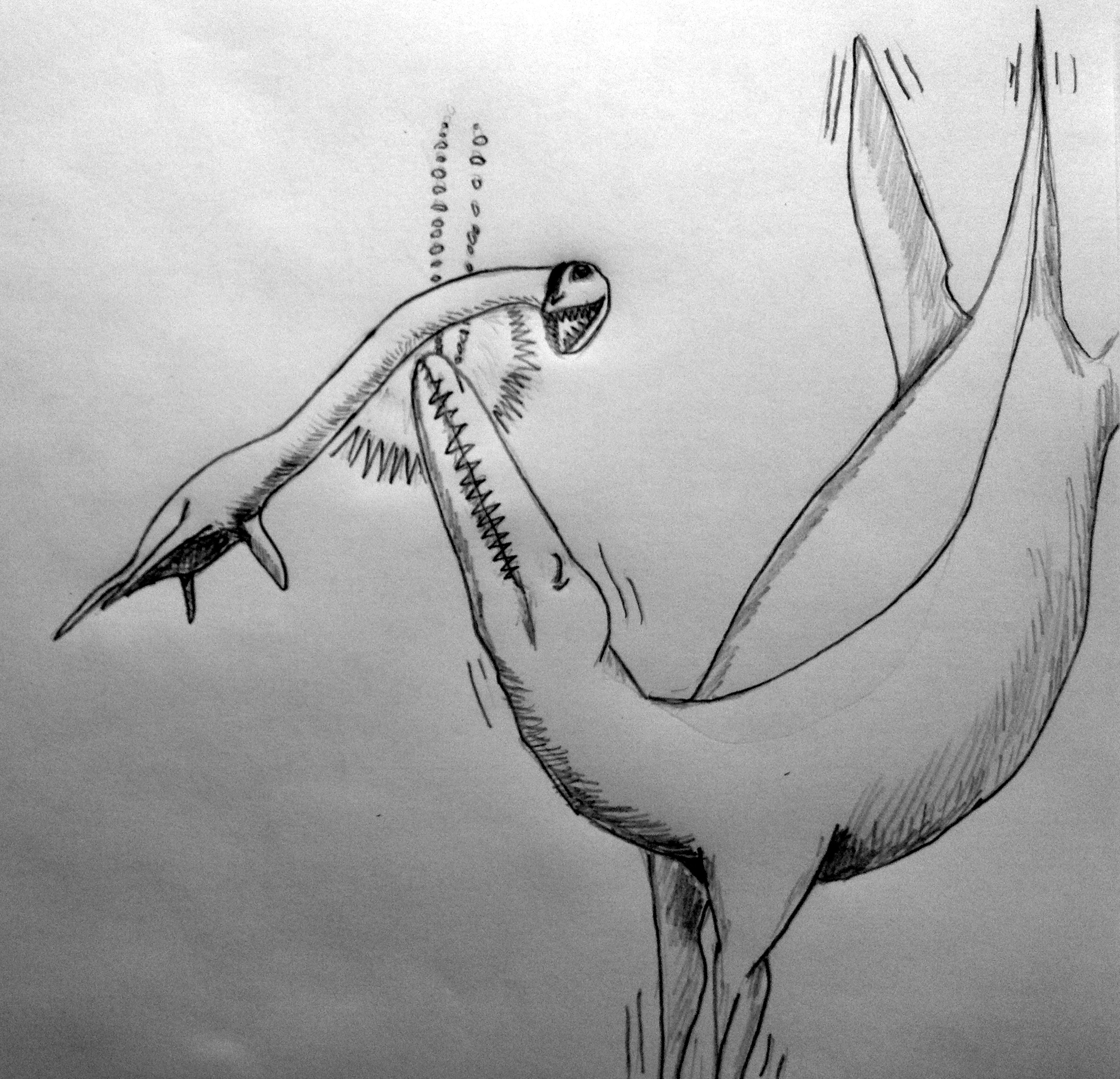
An electrified Elasmosaurus teaching a Pliosaur that it is not a prey item (with apologies to Luis Rey and Robert Bakker)
In Conclusion
Of course this is all speculative, soft-organ paleontology. I haven’t been able to locate a picture of an electric eel skeleton, so I have no idea how electric organs affect bone shape, or whether it’s possible to determine the presence of an electric organ from any skeleton. Some Plesiosaurid neck vertebrae are described as “odd and asymmetric”, but I have no idea whether this could be due to the presence of an electric organ or anything else.
Still, the strength of this hypothesis is that it presents a good explanation of why both Plesiosaurids and Tanystropheids have long, weak, inflexible necks, and it also accounts for how such an animal could be an efficient aquatic or benthic hunter. As such, it is certainly no worse than the idea that they are stealthy hunters, with their bodies hidden by their long necks so that they appear smaller. In fact, it makes them seem rather formidable. Electric sea dragons, anyone?
Offline References
Bakker, Robert. 1986. The Dinosaur Heresies. Zebra Press.
Fraser, Nicholas. 2006. Dawn of the Dinosaurs: Life in the Triassic. Indiana University Press.
Filed under: livable future, Real Science Content, science fiction, Speculation, sustainability, Worldbuilding | Tags: Apocalypse, Deep Future, science fiction
I’ve gotten rather tired of the Mayan apocalypse, and being a contrarian, I’ve been thinking more about the deep future instead of the end of the world.
At some point, I made a sarcastic remark about wanting to write about a world “after the 34th apocalypse, except that I’m too lazy to come up with 33 separate apocalypses.” Now, as 12/21/12 comes closer, I’d thought it might be fun to crowd-source the other 33 apocalypses.
The idea of this is to provide future worlds for SF people to play with. Right now, I feel like SF is suffering from “aging white myopia” in that it’s mostly about the fears and fantasies of aging white people (often men), and myopia because most of the serious SF predictions are in the near future, not the deep future. I’d rather start thinking about 21st century problems, which are more about “how do we deal with this crazy world the Baby Boomers left us” than worrying about the death of the dreams we had as teens.
Want to play? Since I’m hoping to crowd source the apocalypses, I’m perfectly happy if people swipe ideas from here. This is about thinking creatively about global crises, and what comes after them.
Anyway, let’s get to the apocalypses
Here are the end points
1. The First Apocalypse is happening now, with a 5000 gigatonne release of carbon into the atmosphere over the next 200 years (this is the IPCC extreme scenario discussed here. This is the path we’re currently on. Temperatures (and extreme weather) peak between 2500 and 3500 AD, with global mean temperatures peaking 9 to 16 degrees F (6 to 9 deg. C) above today. Sea level rises about 230 feet (80 meters) above today, but it reaches that maximum in 3500 AD (almost all rise happens by 3000 AD). Conditions take 500,000 years to get back to what we have today, and we can assume the fall back towards normal in an approximately linear fashion. Thermal gradients between the arctic and the tropics largely disappear at first, but gradually reappear.
2. The 34th Apocalypse happens 525,000 years from now, when the next ice age starts. This is by fiat, from eyeballing the insolation graphs on Wikipedia. At this point, the last remnants of arctic and high mountain civilization are plowed under by the growing glaciers (antarctic civilization finally disappeared in 400,000 AD under the resurgent southern ice cap). This cycle looks a lot like the last Wisconsin glaciation. Due to the profligacy of the 1st Apocalypse, there is no fossil fuel left to rewarm the earth to avoid the ice.
Those are the end point apocalypses. Here are some ground rules:
–What’s an apocalypse? It’s a global event that causes massive change, global migration, and the end of civilization as we know it, although not necessarily a return to the stone age. It does NOT cause human extinction. It can be natural (an ice age, megavolcano, asteroid), or manmade (our current Gigafart).
–Apocalypses have dates attached, but they aren’t necessarily instantaneous. The Gigafart will take 1500 years to reach its full ripeness.
–Apocalypses have stories attached. Where does Apophis land, and what happens during the impact and afterwards?
–There’s time between apocalypses, time enough for human cultures to recover. In 525,000 AD, there will be enough history, myth, archeology, and paleontology, for the people of that time to know that 33 apocalypses have happened before them, and that they are facing the 34th. This means that the people living between apocalypses have to leave a traces. What do they leave behind that survives?
–The Rule of Narrative Conservation: people will be recognizably human 525,000 years from now. Yes, that’s a long time in human evolutionary terms, but this is for our personal fun. “Recognizably human” means that future people will be close enough to us that it’s no stretch for writers to write about them and readers to emphasize with them. They’re born, live, love, and die, and have recognizable conflicts. There is no end of history, and there is no point at which people stop being people. It does not mean that people will be the same as they are today, and it especially does not mean that they will have the same races as we do today. Races change over the course of a millennium or two, and 525,000 years is an enormous time for racial change.
–I’m tired of reading about zombies, werewolves, and vampires. If you want a monster pandemic apocalypse, be more original.
–Science rules. Don’t bother with Cthulhu, Godzilla, alien invasions (cf the Fermi Paradox), or fairies coming back. Similarly, don’t bother with nanotech or synthbio disassembler plagues, unless you can explain in detail how the damn things work from a biochemical and energetics point of view. Otherwise, they’re magic fairy dust, and that ain’t science.
Those are the basic rules.
One Prebuttal: The simplest way to come up with 32 apocalypses is to assume that global technological civilization is a destructive bubble that pops. All we have to assume is that it takes about 500 years (on average) for global civilization to grow and collapse, and it takes an average of 15,000 years for the Earth to recover enough to support another global civilization, during which people are stuck living as hunter-gatherers, dirt-scratching farmers, and similar Arcadian folk. This idea has been done by Larry Niven et al (The Mote in God’s Eye) and Charles Stross (Palimpsest). I don’t mind the idea of civilization as a cyclical irruption in history, but you know, I’m really hoping for something more original. Future history as a drunkard’s walk, rather than a wheel of time. What about two or more cycles of history, spiked with various and epic natural disasters? Or are there 32 totally predictable global catastrophes lurking out there? Or some mix of both?
Come play Edward Gorey with the future. If we get 34 separate apocalypses, I’ll put it all together and send it out to everyone who contributed.
Filed under: School, standardized tests | Tags: preparation, school, standardized tests
This is off-topic for this blog, but I’m putting this out because school is about to start. It’s advice that worked for me on the PSAT, SAT, and GRE, and it’s worked for others. It also happens to be a bit cheaper than taking a test preparation class. So if you are getting ready to take a standardized test, or know someone who is, read on.
Here’s the advice, for what it’s worth:
–If you want a good vocabulary, READ, especially books that use a lot of specialized or old-fashioned vocabulary. While I liked Harry Potter as an adult, much what passes for YA literature has simple vocabulary, on the apparent assumption that kids are stupid or something. In the long ago days of my youth (the 80s), YA didn’t exist as such, so I was reading adult science fiction and fantasy by the time I was 12. I’d advise the same. Historical romances are another good source, and so is Sherlock Holmes. By all means read War and Peace if you want (or any classic literature), but writers like L. Sprague de Camp delighted in using obscure words, and I learned their meaning from context.
–If you want math skills, do math, and find ways to enjoy it. Old-fashioned skills like drafting (aka drawing things to precise scale), and old-fashioned games like table-top role playing games force you to do a lot of this.
Detecting a bit of “Use it or Lose it?” Yep. The more often you use skills, the less you lose them. Get creative in this regard, and try to find ways to have fun with the skills. This goes for college courses too. If you can get a work-study job in a lab using the skills you want to develop, you’ll do much better on tests later.
That’s the long-term prep. It’s necessary, because if you haven’t read anything other than textbooks before you take the PSAT, you’re going to suffer on the test. Recreational reading (and recreational mathematics, and recreational science) are pretty much the only way I know to get really good, at least before you get a job using these skills. You’ve got to spend hundreds of hours to really master anything, and you don’t get that in school. If you have fun with what you’ve learned, then you get hundreds of extra hours “goofing around.”
Okay, let’s assume you’ve done all this, and you’ve got a test coming up.
First, hopefully you’ve got a month or two before the test. If you just registered for a test next week, what I’m about to say won’t help as much.
In general, tests have two challenges: speed and knowledge. You need to train each of these separately. From talking to a lot of people, speed is probably a bigger problem than knowledge. Many people don’t finish the test, even though they get every question they answer right. Standardized test taking is a specialized skill, and it doesn’t have many uses outside school, so you actually do have to train for it.
Knowledge first: Here’s a hint for cutting your studying by about 70 percent. Buy a book of old tests and take one of those tests, untimed. Put aside a weekend afternoon or an evening to do this. Grade the test. What you will find is that you’re quite good at some things, and need to work on other things. To cut your study time by 70%, concentrate your review almost entirely on the areas you need to work on. Yes, you do need to review the stuff you’re good at, but don’t spend much time on it, because it will waste your time. When most people review for tests (especially the GRE), they start rereading their textbooks front to back. This is a tremendous waste of time, because usually they read the first few chapters, stop, come back a week later, read the first few chapters, stop, come back a week later…you get the idea. Focus only on the subjects you’re having trouble with instead, and use the practice tests to figure out where you are having trouble.
My trick for improving speed was to buy a book of tests and take those tests, one section per day. Usually, the tests have multiple sections (up to eight per test) and each section is supposed to take 20 or 30 minutes. At first, you won’t be able to finish the section in time. That’s okay. Finish it anyway, after noting where you got within the time limit. Afterwards grade your performance, and use it to guide your studies (Remember, only study the things you are having trouble with. If you stop having trouble with something, stop studying it and go onto something else). Note that you’re only taking about 45 minutes per day on this, 20 or 30 minutes to take the test, 10-20 minutes to grade it. Doing this regularly also helps with test anxiety, because test taking becomes a normal part of your day.
What you will likely find is that, after taking one section per day for a while (a week or two), your accuracy will peak. For me, I always missed one or two questions per section, which is what I got on the test. A bit after that, your speed will peak, to the point where you can always get a section done within the time limit. At this point, you’re ready for the test. This is why it helps to start prepping a month or two before the exam. It gives you time to get your speed up.
I realize that test taking has changed, now that many tests are computerized. Fortunately, the basics I used back in the paper test days still seem to work online. Feel free to add other hints, comments, questions, or suggestions in the comments section, and pass this on to any student you know.
This post was inspired by a couple of Charlie Stross’ recent postings, about expectations for 2030, and the future of computing. Also, my Mom’s friend subscribes Chemical and Engineering News, passes them to my Mom, who passes them to me about six months later. I’ve gotten a bit of education about Big Pharma through that, and through friends in the industry. I’m not a pharmacist, but I do like wild speculation, and that’s what I’m writing here.
As of last year (I’m only now seeing 2012 C&EM issues), Big Pharma was having troubles. It costs somewhat north of a billion dollars to bring a new drug to market in the US, mostly due to the costs of testing to meet regulatory requirements. As I understand it, most of that cost (I heard 75%) is salaries. Partly as a result, there’s a phenomenon known as the “Valley of Death” in the process of creating new drugs. That valley lies between discovery of an interesting new potential drug, and when that chemical enters human testing. Big Pharma has been increasingly scrapping their discovery divisions, and focusing on human testing (which is done in places like India, less in the US, to keep costs down. This is a global industry), and far less than 1% of interesting chemicals make it across the Valley of Death to be tested on people. Drug discovery is currently being paid for by government-funded research, and non-profit groups like the Gates Foundation. Weird but true–capitalism seems to require charity to make new drugs.
Now, let’s look at a disruptive technology, the chemputer that prints out chemicals, including potentially drugs. If this gizmo works out (and there’s no reason to think it can’t), then it bids to do to Big Pharma what the internet did to the music, film, and publishing industries. There’s no point in blowing a billion dollars on drug development, if any hacker can print out the drug on demand, using reverse-engineered recipes from another country.
What will Big Pharma do? In the short run, obviously they’re going to send out the lawyers to defend their patents, and I suspect those legal battles will be finally settling down around 2030. I shouldn’t be too flip about this, because there’s a terrible human cost to dismantling the industry: most of that billion plus dollars goes to highly trained drug industry professionals and the people who watch over them, and that’s a lot of people to put out of work. Of course they’re going to fight, just like the American insurance industry fights against government health care. Still, I think the industry is ultimately going to lose, and it will have to adapt or die.
Fortunately, there’s an alternative. The brighter companies will get into the printer business.
Here’s the way it might work. Absent some interesting catastrophe like Peak Oil or a random apocalypse, middle and upper-class people in 2030 will probably have their genomes read as a normal part of their health regimen. They’ll probably even have their epigenomes read, and they might even get a periodic microbiome workup done. They will also likely have all sorts of cute portable monitors for all sorts of conditions, just the way diabetics have their meters now, and they will have all sorts of information on how drugs interact with their particular -omes.
Big Pharma 2.0 could get into this market. They can, for example, offer new parents a free genome and epigenome workup on their new kids, so long as they get to keep a copy of the data for research purposes. Companies may similarly offer free monitoring of a person’s health, so long as they get to keep copies of all the data they get while performing those diagnoses. They can sell the family a printer, and offer to print out the drugs they need (so long as the company can legally produce them), or tell the family when to go to a doctor for more sophisticated care.
What Big Pharma 2.0 is trying to do here is to get people caught up in their technical ecosystem, much as Apple does with their computers. Big Pharma 1.0 already specializes in running human trials, and this is, effectively, a way to recruit human guinea pigs. It doesn’t even particularly matter if the clients of such companies do things like abuse drugs or experiment on themselves. It’s more data for the companies at the other end of the monitor, after all.
As for discovery of new drugs, I suspect the discovery process will come to resemble Amazon’s commercialization of the slush pile even more than it already does. Right now, most drug discovery is done using government funded research, and there’s no reason to think that won’t continue. Certainly, some private individuals will get into the drug discovery game, and their products might even get popular enough that Big Pharma 2.0 picks up their chemicals, and starts offering the experimental drugs through their chemputers.
Wherever they get their experimental drugs, Big Pharma 2.0 can certainly let their clients volunteer to test out new drugs, especially if the clients get paid for it. Since the companies have a lifetime’s medical history for their clients, it’s more defensible medically and statistically to use these well-known volunteers than to recruit random people out of a Mumbai slum for testing. Big Pharma will simply be trading randomly recruited test subjects and an unknown market, for a captive audience of volunteers and patients. They will trade in data and care, not drugs.
I’m not sure what role doctors will play in 2030, assuming people start depending on home diagnostic units and chemical printers to dose themselves. Doctors will certainly continue to treat injuries, deliver babies, treat novel infections, and handle more complex problems. Still, being able to print drugs is going to wildly affect the whole huge medical system, in both good and bad ways. I can imagine people getting harmed by cheaply printed drugs and other such problems, but I can also see people getting better and cheaper care.
What do you think?
Filed under: Colorado Shooting, Real Science Content, Speculation | Tags: Colorado Shooting, Grad school, science
I should be writing a report right now, but that damn shooting at the Dark Knight Rises keeps bothering me, so I thought I’d post my thoughts.
First off, the shooter James Holmes (hereafter Little Jimmy) tried to call himself “the Joker,” and the news media seems to be picking up on this. Quiet, brilliant scientist turns into long wolf monster with no warning! News at 8, noon, 5, and 11! Perhaps I’m cynical, but where I work was close enough to hear the damn news copters orbiting around his parents’ house for hours, and an out-of-town news crew actually stopped us for comment on our way to work out (I told him we were new in town, which wasn’t entirely true).
So let’s demythologize Little Jimmy a bit. Yes, he perpetrated an evil, unjustified act, but in all he was a failure, not a brilliant student and budding scientist, and certainly not the Joker. Let’s run down his record. In fact, let’s really run down his record:
–Bright kid, went to a good high school, got top marks at a good college. Yep, all true, but much as I like UC Riverside (and I know some of the faculty members there), UC Riverside ain’t Harvard. Little Jimmy wasn’t a genius rocketing towards fame and fortune, but just another smart kid.
–Ooh, and he was getting his PhD. True. But Little Jimmy couldn’t land a job out of college, so he went back to grad school. This is a really common move, but evidently the employers didn’t see him as God’s Gift to Neuroscience, for whatever reason. While Colorado is a good school, it ain’t Stanford. Again, this is a smart young man who could have made a decent career, but not a genius.
–He failed to hack grad school, so he quit after a year. Lots of people do this. I’ve known quite a few, including the labmate who committed suicide. It’s a shock to go from being one of the bright undergrads to just another starving grad student, and I suspect it’s getting worse, considering how public schools are getting squeezed by our crazy politics and misguided deans are imposing corporate management models. But I ramble.
Anyway, Little Jimmy may have decided that, since he couldn’t be the next Sigmund Freud, he would try to be the next Charles Manson. So he spends however long acquiring firearms, explosives, body armor, and so forth, and turns his apartment into a discarded set from the second batman film. Do we mention that he calls himself the Joker but dyes his hair orange, not green? Another failure, perhaps.
So he goes on his rampage. What happens?
–His gun jams, thank God. FAIL.
–His major atrocity, the bombs in his apartment, FAILS. Part of this was obviously luck, but…
–He doesn’t die in a blaze of police gunfire. Instead, he surrenders and tells them about the apartment. I hope this was a glimpse of sanity, but who knows? Maybe he wanted to be admired for his evil handiwork.
So yes, he killed at least a dozen people and injured 58 more, destroyed his family’s reputation, and so on, but I do hope that Little Jimmy is remembered as a failure, not as a monster. Based on the presumptive brief glimpse of sanity, I also hope he gets life in prison, and that he grows enough of a conscience to spend the rest of his life regretting his choices.
Was he running amok? In other places, I posted that it certainly looked like it. Now, I’m not quite so sure, but he could have been. For those who don’t know, running amok is a very old phenomenon, Captain Cook, all the way back in 1770, “described the affected individuals as behaving violently without apparent cause and indiscriminately killing or maiming villagers and animals in a frenzied attack. Amok attacks involved an average of 10 victims and ended when the individual was subdued or ‘put down’ by his fellow tribesmen, and frequently killed in the process. According to Malay mythology, running amok was an involuntary behavior caused by the “hantu belian,” or evil tiger spirit entering a person’s body and compelling him or her to behave violently without conscious awareness.” (Source). Not quite what Little Jimmy did, because he planned and prepared for months, but it’s eerie that he dyed his hair orange, not green, and that he killed 12 people, despite having the capacity to kill many times more. Maybe an evil tiger spirit possessed him? It’s as likely as any other post facto explanation pundits are likely to give. Whatever else happened, Little Jimmy was certainly a black swan, and because of that, I distrust any attempts to rationalize his actions.
A rather better idea comes from the August 2012 Wired, in an article called “The Fire Next Time” about how humans mis-process near misses as permission to continue hazardous activities, rather than as warnings to figure out what went wrong and not to repeat it until disaster happens. According to the article, research b the Process Improvement Institute across many industries showed that “there are between 50 and 100 near misses recorded per serious accident, and about 10,000 smaller errors occur during that time.”
Let’s stop blaming the availability of guns, big rifle magazines, the proximity of Columbine near Aurora, or whatever else for Little Jimmy’s atrocity. Instead, let’s look at grad school. I had a rough time in grad school, what with a labmate committing suicide, a conflicted relationship with my advisor, and various chronic injuries that meant I did much of my research in pain. But I didn’t even buy ammunition for the one gun I had, and although I was terribly frustrated and angry many times, sure I was going to fail, I didn’t spend my savings on blowing up anything or killing anyone.
Why not? In my case, the reason was because I couldn’t see anything useful coming from it. I also listened to Garrison Keillor, who can be a wonderful bard about the possibilities of living with failure. And so got on with it, got my PhD and went on.
I’m probably one of those 10,000, someone who could have turned into a monster, had things been a little different in my neurochemistry, my circumstances, or whatever (or whether an evil tiger spirit had noticed me). Possibly I was one of the near misses, people who really should have talked to a counselor, but who worked through their problems without help. Whichever. I do know there are a lot of people like me in grad schools across the country, troubled people who never turn into monsters, who go on to lead productive lives. People who succeed in some fashion, no matter how frustrating the process is.
Little Jimmy Holmes was a failure. People failed to spot the threat he represented, certainly. If nothing else, this might be a wake-up call for grad schools to get a bit more proactive in their students’ social lives (not that I think this will ever happen, but I can dream). Still, even with no intervention whatsoever, only a vanishingly few isolated, angry men of any sort ever turn into monsters. Little Jimmy, for all the deaths and injuries he caused, failed to be as big a monster as he wanted to be, and I’m glad he failed. Good riddance to him.
Instead, let’s praise those who succeeded last Friday, Start with those in the theater who took bullets to protect friends and loved ones, and succeeded, possibly at the cost of their own lives. Let us praise those who helped get others out of the theater, sometimes again getting shot in the process. Let us praise the police who responded quickly, following their training, and caught the murderer. Let us praise all the people who worked for days disarming the apartment. And finally, let us praise all those men and women who get their PhDs in neuroscience and go on to productive careers in many fields. They aren’t the next Sigmund Freuds either, but they are successes. All of them.
Filed under: livable future, Real Science Content, science fiction, Speculation, sustainability, Uncategorized | Tags: grim meathook future, science fiction
I’ve got to admit, starships are intriguing, as is the idea that someone can build a largish skyscraper with a fusion generator in the basement, and that building will contain a village-supporting ecosystem (powered entirely by the fusion generator) and also be missile-proof. On the bad side, this vision seems a bit, I don’t know, silly perhaps? The skyscraper, I mean. That’s effectively what a starship is, though, and existence of one implies the other.
On the other hand, we can assume the obvious answer for the Fermi Paradox, that the reason we haven’t heard from aliens is that starships are logistically impossible, even if they are possible under the laws of physics. This comes about simply because starships require so many breakthroughs in so many fields. A failure to achieve any of these breakthroughs–power plant, shielding, compact, human-supporting biospheres (or stasis, or computer upload systems that last for centuries), and keeping the crew together for the duration of the voyage–dooms the starship. All of them could be impossible.
At this point, some SF aficionados throw up their hands and scream “therefore we’re all doomed! The Earth won’t last forever, and humans have to.” This is foolish. Yes, of course we’re all doomed to die, one way or another (sorry if this is unwelcome news), but Earth has another billion or more years to run before it becomes uninhabitable, and it’s quite likely that humans on Earth have another few million years before we go extinct, no matter how stupid we are.
The basic point here is that humans will almost certainly survive a transition from our current, fossil-fuel based, economy to one that is not based on fossil fuels, and the only reason I say “almost certainly” is because I’m currently reading Legacy of Ashes: The History of the CIA, and cringing how many attempted suicides the US unknowingly avoided. Anyway, the point is that people will survive, whether we decide to end our dependence on fossil fuels by crashing civilization, or whether we get to innovating and finding ways to do more with less, just as we have for untold centuries.
What will that future look like? In some ways, it will look like the starship future, at least for the next few centuries. As we get nine billion people on the planet, we’re going to have to find ways to feed more people with less land and water. Given how much we currently waste, this may be possible, if not pleasant.
Other predictions:
–Oceanic fishing will largely disappear for centuries. There are so many anoxic zones already that it’s likely that most people will give up fishing, and ships will have to carry all their food with them. I’ve had fun imagining a future Pacific where big, ark-like windjammers travel among the islands, all the food grown or shipped with them and fresh water recycled aboard as much as possible. The islands that survive sea level rise may start to resemble the self-sufficient dome cities of the previous post, since they’ll be less able (or entirely unable) to draw on the sea for their livelihoods. This is a grim thought for those of us who admire the old Polynesian cultures, but fodder for any SF writer who wants to re-imagine the old idea of asteroid belt colonies out in the Pacific, with kite-sailers replacing singleships. Anyone want to mine lava for precious elements?
–Farming will change. We’ll probably start recycling sewage onto farmland (if only to recapture the phosphorus, since we’re running short of mineable sources for that essential element), and we’ll certainly eat less meat. We’re already getting a powerful taste of climate change, with those record-breaking heatwaves and storms, and it’s going to get worse. We’ll have to get used to the idea of crops failing, and we’ll have to get very good at storing food during the good years. Currently, big agribusiness has a lock on both the food economy and politics, but that may fail suddenly, if the few big companies that dominate the Ag industry fail to deal adequately with crop failures, changing climate zones, and other problems. Rural America has been “dumbed down” for most of a century, with the bright kids lured into the cities. We’re facing a time when we need really, really smart farmers. I suspect we’ll get them, and this will affect both agribusiness and politics. Personally, I hope that permaculture takes off in a big way, but that’s because I’m an ecologist and I think it’s cool.
–Politics: It’s amazing how much politics in the US is affected by air conditioners. If the amazingly complicated US power grid starts to fail, people are going to start migrating north, out of current red states and into the blue. Some people say this is what’s driving the current Republican party, and they may be right. America is getting less white, and throughout much of the world, we’re seeing smaller families. There will be a gerontocracy for the rest of our lives, I’m afraid, but after that, who knows? We’re so used to thinking of political economy as growth that it will take innovation to face a future where populations decline.
I could go on, because this is the kind of future that makes more sense to me. Perhaps it’s because I’m a pessimist? Or is it that the idea of human history having millions of years of one damn thing after another is actually more appealing than centuries of adolescent style, unlimited growth? For SF writers, there is good news here:
–there are plenty of Apocalypses to go around. If we really do live for millions of years, we’ll see the end of the fossil fuel age (in the geologic near term), the end of global warming (as I posted on a while back), at least one more ice age, multiple Carrington Events, asteroid strikes, devastating earthquakes and volcanoes, east Kilauea sliding into the sea and inundating the west coast, dogs and cats living together, and so forth. I was toying with the idea of starting an SF scenario called “after the 34th apocalypse” set waaaay far in the future, but I would have had to figure out what all 34 apocalypses would be. The point would be that the end of civilization as we know it might become old hat after a while, with coping strategies and everything.
–Many futures are possible. Given a combination of limited resources and humanity’s incredible capacity for ignorance, boredom, and self-delusion, I predict that people are going to try most options repeatedly. Everything from slaughterhouse dictatorships to drop-out wannabe utopias will appear again and again. Modern giant agribusiness isn’t the first time western civilization tried huge agriculture (see latifundias), and it’s certainly not going to be the last time, although I’m sure we’ll see periods of small farms in the near future. Dictatorships will come and go, and there will always be a new religion popping up somewhere, even if most of them don’t survive much past their creators’ lifespans.
–Science will always be around. It’s common knowledge that most of the world’s current great religions (Christianity, Buddhism, Taoism, Hinduism in its current incarnation, and Islam) were created during the so-called “Axial Age” of empires in Rome, India, and China. They and their descendents are still around, in massively altered form. We’re centuries in to another age of global empires, and I’ve been wondering what new form of religion will come about. The answer was so obvious that I almost missed it: science. History is accretionary, not cyclical. Although Christianity is monotheistic, it early on absorbed a whole body of saints and pagan holidays from the old religions it replaced. Islam and Buddhism did the same thing, and I think the trend is universal among missionary religions. Because of this, I’m pretty sure science won’t go away either, no matter how hard people try to suppress its inconvenient truths. It’s so embedded in all of our lives that, like the notion that God should be capitalized, it’s not going to go away. Science *will* change radically in coming centuries as it subsumes arising cultures, but people will keep doing it. When we go through future ages of upheaval and global empires in coming millennia, our descendents will likely come up with still other “religions” that fundamentally change the way we think. I wonder what they will be?
–Domestication will rule much of the world. As with ants and termites, the human species’ fundamental adaptation has been domestication, which I like to describe as a massive campaign of symbiotic adaptations. While we can live without agriculture, I don’t think we’re going to do so. It’s simply too useful. Rather, I think that evolution is going to continue to take advantage of our domesticated ecosystems, just as it is doing right now. We will see more pests, pathogens, and parasites (including social parasites), and they will only get more sophisticated through coming centuries. I’m quite sure our counter-measures will get more sophisticated too, in a coevolutionary arms race, and I suspect that agriculture in, say, 40,000 years, will look radically different than it looks today. Farm ecosystems will be much more complex, and much of that complexity will be outside human control. Fortunately, I don’t think wilderness will ever entirely vanish, either.
–Similarly, I don’t think machines are going away, and I think that the complexity of mechanized ecosystems will only increase over time. I also think it’s likely that domesticated and mechanical ecosystems will merge more thoroughly than they have already.
In other words, there will be grim meat-hook futures, but I suspect that for every grim meat-hook generation, the next generation will make the best of things, get on with life, and be relatively happy. Things could be worse.
 Putting the life back in science fiction