


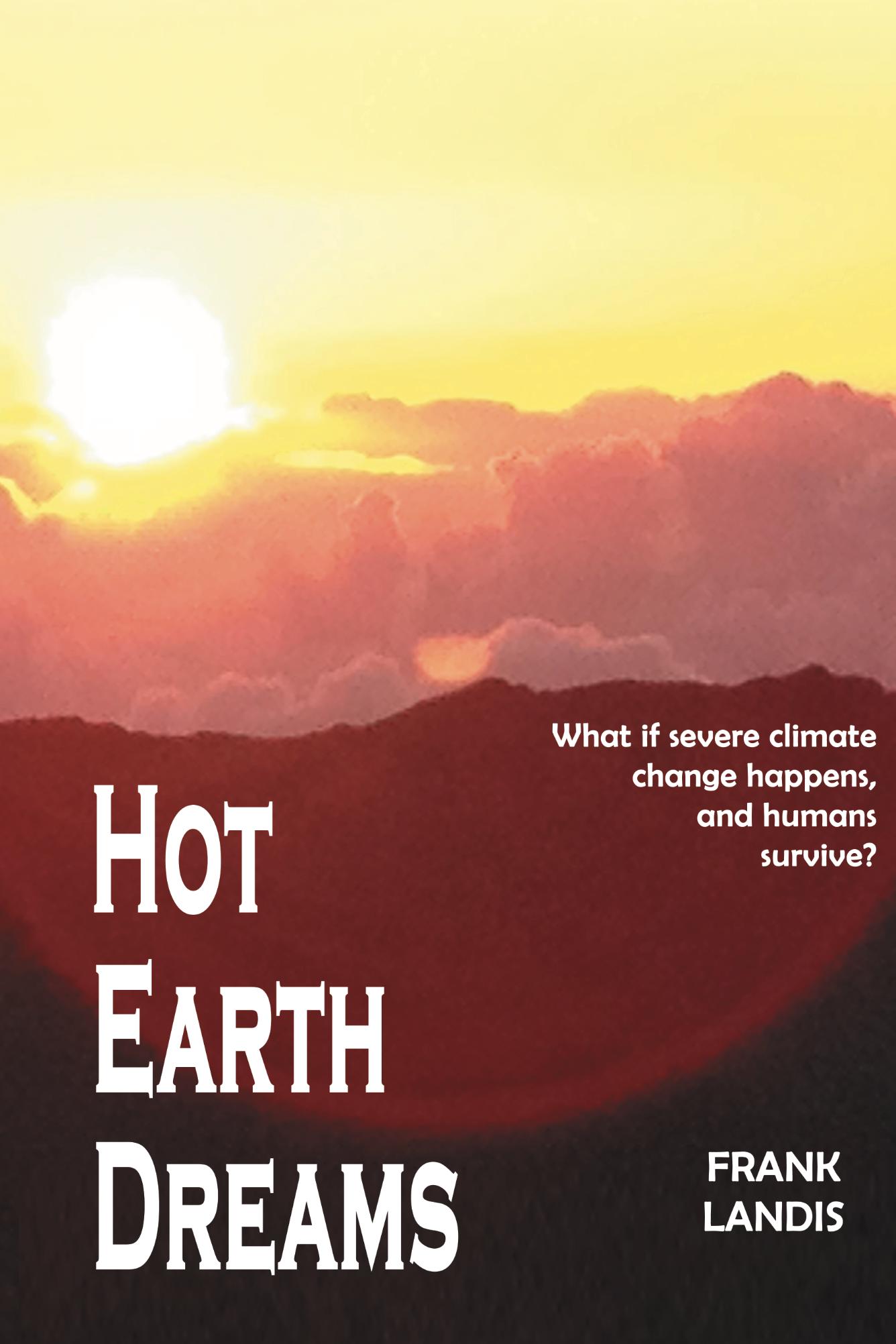
Here’s the official comment thread for Hot Earth Dreams. Comments, questions, errata, typos, other feedback. Yes, positive feedback is very much welcome. Note that this is for the whole book, not just for the first five chapters in the sample.
1/25 update: Welcome Legalise-Freedom listeners and Archdruid Report readers! You can read the first five chapters and see the cover here.
Here is where Hot Earth Dreams is available:
Createspace as a paperback (https://www.createspace.com/5799140),
Amazon as a paperback (http://www.amazon.com/Hot-Earth-Dreams-climate-happens/dp/1517799392),
Kindle as a mobi (https://www.amazon.com/gp/product/B017S5NDK8),
Barnes and Noble as a paperback (http://www.barnesandnoble.com/w/hot-earth-dreams-frank-landis-phd/1122947640),
Kobo as an epub (https://store.kobobooks.com/en-us/ebook/hot-earth-dreams),
Smashwords as an epub, mobi, or lrf (https://www.smashwords.com/books/view/593567).
All the ebook formats should not contain DRM. Please let me know if they do.
Charlie Stross also allowed me to post a guest-blog at his site . I’m not going to cross-post too much information, but there is one critical point:
Thank you to all the people who’ve read my posts, and, most especially, to those who have commented on them. Over the last three years, I’ve tried out ideas from Hot Earth Dreams here, and the feedback I got, both positive and negative, really shaped what went into that book. I couldn’t have done it without you, so thank you very much for your help, and I hope you enjoy it.
Well, one other thing: my publishing strategy is to self-publish first, to see how well it does. I’m planning on shopping it around to mainstream non-fiction publishers, but according to what I’ve been told, a big part of a successful non-fiction proposal is the size of my existing audience. If enough copies sell, it will level up to a publishing house, which will help get it in book stores, libraries, reviewed, and so forth. This, of course, is where you come in. If you like this book, review it online, tell your friends, talk about it, spread the word. That’s the best advertising I can get right now, along with blurbs from Big Names (and if you are one, let me know)
Filed under: book, futurism, Hot Earth Dreams, Real Science Content, Speculation | Tags: books, ebooks
Well, I was hoping to get that book out by now, but thanks to life intervening and Ol’ BigMuddy doing something interesting with the formatting, not to mention another round of copy editing, I’m planning to release it November 15, although that’s a soft deadline. The release will be a paperback version and a Kindle version, both available on Ol’ BigMuddy, in as many markets as I can get it into.
To whet your appetites, here’s a pdf sample from the paperback. Enjoy!
(update: you can see where to buy it here)
Filed under: futurism, livable future, Preludes | Tags: climate change, Deep Future, grim meathook future, livable future, preparation
Might as well finish up the triptych.
In my simplistic way, I figure that if we were a spacefaring species, we could build skyscrapers in places such as, oh, the Atacama desert, and a group of people could live in them for years without going outside or going insane. These skyscrapers would be mostly greenhouses and recycling facilities, with relatively small living quarters. Such buildings are basically spacecraft or colonies, minus the propulsion.
If we were a starfaring culture using STL ships, such buildings would also be able to ward off artillery, possibly a nuclear strike. We’d need similar shielding to fall between the stars at high speeds. Oh, and people could live happily inside for centuries, even while it’s getting bombed.
If we were able to do high tech sustainability, we could build something like a city-state, where a city and its farmlands were mostly self-sufficient. Such a city wouldn’t look much like what we have now, at least in the US. Large areas within it would be dedicated to rebuilding, reworking, and recycling stuff. The water that flowed out of it would likely be as clean as whatever flowed in, and waste from the city would feed the fields, which probably wouldn’t smell all that good as a result.
The only reason to bring this up is to provide a sort of conceptual nested Venn diagram, with starfaring cultures at the extreme center, spacefaring cultures engulfing them but still extreme, sustainable cultures engulfing both, and where we are now, with less overlap between their hypothetical space and our space than we might hope. Unfortunately, we don’t know whether high tech sustainability, let alone space colonization and starflight, are even possible. In the latter case, it makes you realize why so many SF writers put jump drives on their starships, so they can pop the action from one planet to another without dealing with the difficult problem of living in space. If there’s one underlying message, it’s that life in space depends first and foremost on long-term sustainability in extreme environments. In other words, we have to learn to live sustainably on Earth before we can begin to hope to colonize some other planet. If we can’t solve our problems here, we can’t hope to survive running away from them into space.
Then there’s the other side of the Venn diagram, where the preppers prepare for collapse. Unlike the space side, they’re real, if only because we know that collapses happen and people survive, but there’s less overlap between them and current civilization than we might hope.
In its way, post-collapse culture is another type of sustainability, where there are fewer people and there’s no little or no long-distance trade, but it’s not quite as simple as most people think.
There are two issues. One is that many people are preparing for the wrong disaster. Many prepare for natural disasters, at least for short term survival (I do that). Some prepare for the collapse of the US or some more paranoid future (black helicopters, laws comin’ after yer guns, and so forth). Some special types prepare for things like a zombie apocalypse. Rather fewer seem to prepare for climate change, and that’s a problem.
Yes, the book is still marching towards publication (soon!), but I didn’t spend much space in it telling people how to prepare for living in a changed climate. The challenge isn’t figuring out how the climate will change (we’re closing off options as we speak). The problem is that the climate will keep changing for hundreds of years, however it changes. There’s not one set of preparations that anyone can make that are guaranteed to work over the long term. A lot depends on luck, no matter what happens.
As the climate continues to change, people can move to follow a particular climate that they know how to live with (say weather to grow corn or wheat) while adapting to new lands. There are problems with this–climates are averages of weather, and the weather’s getting weirder as well–so it’s not as simple as moving north every few years and planting the same crops each time, but something similar worked for the Polynesians, so why not try it? The other alternative is that people can stay in a place that they know and deal with the weather continually changing, on the theory that, because they know their lands, they can continually adapt to whatever the climate throws their way. I suspect each strategy will work fairly well at particular places and times, but I have no idea whether one is a better strategy in general.
The other problem is that preparing for the collapse of civilization is not as simple as readopting the lifeways of our pioneer ancestors or the indigenes they displaced, because 20th and 21st Century global civilization is profoundly changing the planet. The Old Ones were able to depend on plants and animals (like, say, passenger pigeons), that probably won’t make it past the 21st Century, given how populations of everything from ginseng to mountain sheep are dropping all over the world. Similarly, we’re doing a pretty good job of depleting groundwater all over the world, so there will be fewer springs, oases, and streams to depend on, and rather more of them will be polluted. A world where global civilization has collapsed will be a lot harsher, with fewer natural resources and rather more junk to sort through. It’s not necessarily unlivable, but it’s a new world, not an old one. Survival in it depends on a mix of old and new skills.
Still, there are things we can do now to prepare, such as designing the tools and technologies our descendants will need to survive. My favorite example of this are the rocket stoves and their kin, super-efficient wood-burning stoves that are being built for the developing world. There are a huge number of similar technologies that could, and should, be developed.
In general, designing for collapse involves figuring out ways to solve problems by cleverly using local resources and less energy. Going back to the example of the rocket stoves, currently they’re built in factories and shipped worldwide. In a post collapse world they’d have to be built from scrap by village tinkers. It’s far from impossible, but we’re not thinking much about what kinds of designs can be made from repurposed stuff. Hopefully that will change.
If we’re prepping for climate change and collapse, I hope that one way we do it is to encourage hobbyists, makers, and students to start designing post-collapse tech now. If I knew anyone who was interested, I’d encourage them to figure out things that can be built from garbage, recyclables, whatever, designs that are simple but not necessarily obvious, designs for things like medical equipment, lighting, paper, fire starters, water and soil purifiers, and so forth. They won’t necessarily be economically viable now, but now we’ve still got the time to experiment with designs, the resources to allow prototypes to fail and be refined. If we wait until things really start heating up, we won’t have these luxuries, and a lot of people will suffer as a result.
Collapse is ultimately another form of sustainability. As I like to tell people, over the next century or so, we’ll utterly transform our civilization into something more sustainable. Either we’ll figure out high tech sustainability using renewable energy and transform our world into high tech sustainabilistan, or we’ll harness renewable energy as the few survivors chop wood to feed our fires midst the ruins. Either way we’ll be sustainable. What we’re working on right now are the details about what we’re willing to endure during the transformation, how many people we can support afterwards, and what happens to the planet as a result. Not getting to sustainability is really not an option any more.
Filed under: futurism, Preludes, sustainability | Tags: cli fi, climate change, Deep Future, sustainability
I guess there’s a theme to be mined here.
Going from the same idea as the previous blog post, Preludes to Space, it’s worth looking at how well our society is getting on with that whole, mysterious sustainability thing.
There are two problems with sustainability, at least in my weird opinion. One is that we know how to do it, if we’re talking about your basic, semi-isolated, neolithic society, with some offshoots to your basic, isolated iron age society, and we’re talking about time periods no longer than a few centuries. The “high tech” outliers are the Greenland Vikings, who made a go of it for around 500 years, and the Japanese under the Shogun, who pulled it off for around 200 years (note that Jared Diamond got weird about this in Collapse). Otherwise, again, we’re talking about the Polynesians and other islanders, and all the “primitive” cultures that imperialist forces have conquered over the last 500 years, all of whom were more or less sustainable. In other words, if we go low tech and low population numbers, we pretty much know what sustainability looks like, because that was the world a few thousand years ago. With ten billion people and high tech, we’re pretty clueless about sustainability looks like, except we have this feeling that we’re better than we were before, so it should be easier to get to sustainable than it’s proving to be.
The other problem is that we’re kind of in outbreak mode right now, sort of like gypsy moth apes. Technically, this is called the Enemy Release Hypothesis in ecology, where species that can evade or overcome their natural enemies (predators, pest, parasites, and pathogens) can dramatically expand their numbers. This is almost always temporary, because eventually the natural enemies find their prey, and prey numbers crash. In human terms, we’ve released ourselves through things like medicine and public health to control our pathogens and parasites, using veterinary science and plant pathology to help our domestic species avoid predators other than us, killing any predator that comes after us and our symbionts (aka our domestic species), and throwing billions of dollars at the industries that promise to keep doing this for the foreseeable future.
This situation is metastable in many ways. Medicine’s chief tools–antibiotics–have a short effective lifespan, we’re amazingly stupid about maintaining public health infrastructure like sewers and water lines, and all of it depends on fossil fuel sources that are running out. We could, very easily, open ourselves to our enemies, and then disease and famine would reduce our population down to sustainable levels of a hundred million or so.
Still, simple-minded sustainability is the notion that we can make our outbreak permanent, keep our population fairly high indefinitely using renewable energy and recycling all our stuff. Crashing back to sustainability is idea of civilization collapse, which I’m going to get to in the next post. In any case, there are precedents for us turning the outbreak of a new clade into the new normal. The cyanobacteria did it, although it took them over a billion years to start running the biosphere’s oxygen atmosphere. Ants, termites, and bees have done it in the insect world. Mycorrhizal plants did it 400 million years ago. There’s no physical reason we can’t keep human populations high and run them sustainably. However, there’s no physical reason to assume that we can pull it off either. We’re in unknown territory, and there are many species on Earth right now that can expand into outbreaks but not sustain their high numbers. Sustainability at high number is very unlikely, but fortunately, it’s not impossible.
What does sustainable technology look like? The most restrictive case is what I talked about in Preludes to Space: we can only colonize space on a sustainable basis, so if we want to colonize other planets, we have to solve the sustainability problem too. Still, there are many technologies which are sustainable here but which won’t work in space. It’s rather more possible that we’ll get to sustainable and find out that we still can’t colonize other planets.
There are huge number of complexities involved with sustainability, but there a couple of general problems. One is that we have to learn how to power our civilization off renewables, and nuclear fusion, if that’s possible (sorry, I’m not interested in entertaining the eternal nuclear-uranium-thorium-we can do it–don’t tell me to shut up discussion here) . Another problem is that we need to recycle basically every element. Since we can argue about power endlessly, I’m going to focus on the recycling issue here.
As I’ve noted before, I’ve got a relative who deals with solid waste issues on a regular basis, and I can tell you that there are hundreds, if not thousands, of schemes to recycle just about everything. Most of them are unworkable, because they demand that the trash coming in is very homogeneous: it has to be all greenwaste from yards, or fluorescent bulbs, or used diapers, or used lumber from construction, or whatever. Throw a broken fluorescent bulb in the greenwaste, and it’s unrecyclable for both. The trash stream most cities deal with is extremely heterogeneous, which is why a lot of it ends up in landfills. Polluters range from careless to stupid to evil, and there are two generally proven methods for dealing with waste: dumping it (which we do with trash and sewage) and hand sorting it (which we do with recyclables, many of which end up in the trash anyway because they’re not cost-effective to remanufacture). To get to sustainable, we need to be able to recycle everything, so (for instance) nutrients go from farms to food to compost and sewage, to fertilizer back on the farm. This would be great, if a large hosts of pathogens and contaminants didn’t ride along on the recycling stream and contaminate our food supply and the supply of every other resource.
Still, it can be done, and it is routinely done in Third World cities, where sewage is used as cheap farm fertilizer and the desperately poor sort through the trash for anything they can sell. Our problem in the developed world is that we see the resulting disease, discrimination, and poverty of such cultural recycling as environmental justice issues that often are inflicted on minorities. We want to find ways for to do it equitably, so that everyone gets to be healthy and not poor, even if they’re dealing with waste. That’s a much harder problem.
Actually, just keeping streams of materials homogeneous is the most difficult problem here. Every time we can figure out how to recycle something cleanly, it becomes a reasonably good industry. The problem is when recycables get contaminated. For example, back 50 years ago, glass bottles for wine, milk, and soda were routinely recycled. One perennial problem is that someone would, say, use a milk bottle to store used motor oil until he could dump it somewhere. Then he’d turn the polluted bottle back in for a refund, sticking the recycler with the chore of decontaminating the bottle before it was refilled with milk, or throwing the bottle out and losing the resource. It’s a ubiquitous problem with recycling. Recycled steel needs to have steel in it and not a lot of silicon from dirt, recycled medical supplies have to be sterile, glass has to be all the same composition, recycled electronics chips have to be pure, and so forth.Again, it’s a difficult problem, not necessarily an impossible one. We can hope that there are some technical solutions out there, as well as cultural ones.
Still, as with a culture that is preadapted to colonize space, a society that is high tech and sustainable will look strange to our eyes. Their social mores will be different, especially around handling waste materials. They’ll be much more sophisticated and thoughtful about recycling, and they’ll probably be disgusted by different things than we are. Indeed, they won’t be consumers in the modern sense, because consuming stuff and throwing it out won’t be the cornerstone of their identities. They might come off as a bunch of enviro-prigs compared to us, but they’ll think we’re pretty disgusting too.
Filed under: colonizing space, futurism, Oceania, Preludes | Tags: Bill Nye, Elon Musk, Neil DeGrasse Tyson, Polynesia, space colonization
While I haven’t seen The Martian yet, as a trained botanist, I’m wondering why they didn’t identify the protagonist as the Master Gardener of Mars. Botany as a science really isn’t that useful on Mars, and what you really need is a good horticulturalist.
Still, this got me thinking. I’ll admit I’m a big fan of Oceania, and part of that is because the Oceanians–the Polynesians, Micronesians, Melanesians, and Australian aborigines–inhabit some of the most difficult and alien areas parts of the planet, even if we think of them (erroneously) as paradise. Moreover, the settlement of Oceania is a good testimony to how hard it is to settle such alien environments. I’m not the only one who thinks this way either. Dr. Ben Finney, Anthropology Professor Emeritus at U. Hawaii, is both a founding member of the Polynesian Voyaging Society (google Hokule’a), a member of the Planetary Society, and someone who has written multiple articles for NASA on what Pacific anthropology can teach NASA about colonizing space.
Anyway, what’s so alien about Polynesia? For one thing, none of the islands could support humans very well at all without the plants and animals that the Polynesians brought with them from South East Asia and the Papuan Islands. These include pigs, chickens, taro, bananas, yams, bamboo, sugar cane, kava, and so forth. The Polynesians also got sweet potatoes from South America somewhere around 800-1200 CE, but that’s another set of voyages, and I’m getting off track. The key problem for settling Polynesia is that you’ve got to settle coral atolls as a necessary step to getting to most of the bigger islands. Coral atolls have plenty of fish, but they have no usable stone (atoll dwellers used clam shells for hard tools), limited water, and few plants can grow there. In addition to building deep sea ships and learning how to navigate well beyond the sight of land, the islanders had to adapt their entire lifestyles to live on atolls, including learning how to build deep sea ships there, which is a real trick. This adaptation meant they abandoned ancient technologies like pottery and knapping stone, because neither clay nor stone were available. For all we know, they even abandoned bronze, but that’s much more speculative. Once their descendants reached big islands like Hawai’i, they didn’t reinvent pottery or flintknapping, but kept making tools using techniques that worked as well on clamshells as they do on basalt.
If we’re thinking about humans colonizing space, there are a couple of lessons in Polynesian history. One is that we’ve got to learn to settle space before we colonize other planets. It’s not just a matter of building a better spaceship, it’s a matter of learning how to live in space, on the Moon, on asteroids, as well as colonizing Mars, the Jovian satellites, and so forth. This is a giant cultural revolution. The descendants of the spacers will colonize other planets, but they won’t be moving, say, American car culture to another planet. They’ll be adapting how their ancestors lived in space to settling the surfaces of these new worlds. This is something science fiction routinely gets wrong.
The bigger lessons, though, are that colonizing the islands involved whole suites of adaptations from all over, it took a long time, and it was a marginal activity. The Polynesians had ancestors from everywhere from Taiwan and the Philippines to the Solomon islands, and their dozens of domestic plants and animals came from a similarly wide swath, everything from Asian chickens to Melanesian kava. While the Islands near Papua New Guinea were all colonized by ca. 13,000 years ago, it took until about 3,500 years ago for the Lapita ancestors of the Polynesians to start colonizing the Solomon Islands and from there to Fiji and Samoa. Just being able to sail a canoe doesn’t make it possible to settle islands across the Pacific, any more than sending a rover to Mars makes it possible for humans to live there. And those Lapita people? They were beach bums and yachties, fisherfolk who lived near the water, traveled among the islands, possibly traded pots and such, and who definitely hadn’t settled the interiors of all the islands they visited. They lived on the margins, waterfolk rather than landsmen.
What if the settlement of space was a replay of the settlement of Oceania? Well, looking around, we’re in that window where we’ve got ships, but we don’t know how to live on little islands yet, or even how to survive beyond cislunar space. It might take us 10,000 years to get to Mars, too.
One of the ways you can gauge our readiness for space is to look at what I’ll call the Preludes to Space: all the technological precursors that we need to survive up there. Yeah, we’ve got rockets. So what? Life support’s a bigger problem right now. There are a lot of things we don’t have and don’t know how to do.
For example, if we were ready to colonize space, we wouldn’t be worrying about climate change. On the scale of hell, a severely climate changed Earth is still massively more benign than Mars, let alone the Moon, Ganymede, or Mercury. Keeping people fed, watered, housed, and living meaningful lives is going to be a problem anywhere there are people. If we were serious about space, we’d be investing far more in things like water recycling and compact food production, and we’d be focused on deploying these technologies in places like Syrian refugee camps in Jordan.
Think about the refugee experience in a place, like Jordan, that is severely water stressed as it is. If we had spaceworthy life support, we’d have things like, oh, hydroponic gardens in shipping containers, where the plants grew under LED lights powered by solar panels, water and nutrients would be mostly recycled and highly efficient, and a shipping container could support a family more or less indefinitely with the right nutrient inputs, which should ideally come out of recycling the family’s sewage and wash-water. And such a system would be cheap enough that we could build hundreds of thousands of them and ship them to refugee camps around the world, or indeed, to any disaster area.
No, I haven’t run the numbers to see if this would actually work, but that’s about the scale of technology we need as a prelude before we’re ready to settle space, because once we’re in space, we’ll have to learn how to make those technologies using whatever materials are locally available. Space colonies aren’t domed cities, they’re basically giant collections of greenhouses with tiny homes attached, except that the greenhouses have to be buried, the plants fed by LEDs, and the systems run off solar panels or something similar, to protect against everything from radiation to meteorites.
That’s what the preludes to space look like. They’re pieces of a cultural tool kit that includes everything from building ships to life support. If we were ready for space, let alone the stars, our planet would have a rather different set of crises than it does now, and our ability to cope with them would be much more sophisticated. But we’re not ready yet.
If the space-nuts had any sense, they’d be investing hugely in developing life support systems and deploying them, not in high end cities, but in refugee camps, slums, and similar harsh places where life is marginal, because life will be marginal in space too. Polynesia wasn’t settled by a mass migration of overcrowded Papuans heading for Fiji, but by fisherfolk figuring out how to live on beaches anywhere in the tropical Pacific, and heading out and on.
Feel free to tell Elon Mush, Neil DeGrasse Tyson, and Bill Nye that I said this, too. They’re going to need a bigger toolkit if they really want to tackle this.
I’ve been indexing the manuscript, and as with everything associated with this book, it’s more involved than I thought it would be. Fortunately, rather than lunging in to use Word’s indexing functions, I decided to read Nancy Mulvany’s very good Indexing Books, Second Edition (link to BigMuddy), so I learned that everything I was ready to do was, shall we say, suboptimal? Yes, this is a textbook for people who create indices, and I do advise reading it before you launch into indexing.
It’s not that indexing is technically difficult, it’s that an index is a “paratext” (a parasitic separate text?) that reorganizes the book to enable someone looking for a particular bit of text to rapidly find it. Creating one can’t be done by machine, because the essential trick is getting inside the readers’ minds and anticipating how they will search for information and what they will search for. Yes, I could hire someone to do it for me, but that would cost hard money, and this is definitely a soft money project. So I’m lumping it myself, and hoping that I can figure out how you’re going to go looking through the index.
One grumble about Mulvany’s book is that I decided to get the Kindle edition. It has a beautiful index, of course, but all the Kindle converters did was to copy the index as if it was a table, so on my little Paperwhite, I can’t enlarge it. All I have is page after page of two column index in flyspeck 3 font, too small to read without a magnifying glass, no links, page numbers noted and irrelevant in a Kindle edition. In other words, in a textbook on indexing, the index on my version is totally useless.
Very few ebooks have functional, hyperlinked indices, but if I’m not being overly ambitious, I’m going to try to make a working index for the electronic version of my book. Right now it looks like creating the electronic index involves radically reformatting the manuscript, feeding it into Caliber, and likely as not making various and unspeakable sacrifices to nameless deities. Whether Amazon will carry the resulting file is another one of those interesting questions that hopefully I can answer in the next month or two.
While I could easily rant on about how ebooks are worse than paper books, I think this makes the case. It’s beyond silly to have an electronic document with no hyperlinks and no way to resize images, but that’s what I’m supposed to create, unless I put in some extra effort. Oh well. Good thing I’m stubborn.
The only take-home from this is that if you care about your readers having an index handy, put the requisite effort into it. If you’re into DIY indexing, Mulvaney’s book is required reading, and if you’re planning on selling your manuscript (especially if it’s non-fiction), get the Chicago Manual of Style (preferably the dead tree version), because apparently it has warped brains in the American publishing industry more than other style manuals, and they will expect you to follow it, except when they don’t.
Back to the coal face.
Filed under: fantasy, science fiction | Tags: cli fi, SFF literature, The Onion
I have no literary pretensions, so my favorite book review comes from The Onion’s online book review every Monday. Back on September 7, Kyle Fowle reviewed Salman Rushdie’s venture into fantasy, Two Years Eight Months And Twenty-Eight Nights (link to the review). Here’s how the review opens:
“Genre fiction has always been poking around the mainstream, but now more than ever it’s enjoying unprecedented success. Sci-fi and historical fiction, fantasy and bawdy romance, superheroes and dragons, are an integral part of the mainstream media diet, be it in literature, television, or film. Perhaps it’s no surprise that fantasy and sci-fi are enjoying widespread appeal. After all, most can relate to the way those genres explore class division, oppression, economic and moral collapse, and the constant fight between good and evil. Such themes feel particularly relevant and urgent in 2015, and the best fantasy and sci-fi writing isn’t an outlandish exploration of the future or some magical past, but a insightful examination of our current culture.” (emphasis added)
Of course I disagree with that last statement. I’m with Tolkien, in that I’m not terribly interested in writing allegories about the modern age, although I agree that good stories have taken this tack. Perhaps this is an example of someone attempting to turn personal taste into dogma? We can also debate whether LOTR, Harry Potter, ASOIF, Star Wars, or Dune are insightful examinations of the cultures of their times, or just worth consuming on their own terms.
Building on the last blog entry, “White Men in the Jungle, I’d say this perception of what makes quality fiction is another problem with cli-fi. My interest is in exploring what, to me, looks like a very outlandish future, to give people an idea of where we’re headed if we keep blowin’ GHGs and swiggin’ every resource in sight. Cli-fi that’s an “insightful examination of our current culture” is inevitably dystopian, sometimes narcissistically so, all about how we’re screwing up, something that all too often turns into a jeremiad. Indeed, it seems that people expect cli-fi to be about the jeremiad, to explore the ways in which the results of our sins will be visited on our descendants, if not to wallow in it.
But I love real creativity, and I think the most creative solutions happen within harsh limits. For instance, I love traditional Inuit kayaks and Micronesian flying proas, because they’re two examples of incredibly creative people taking almost nothing and making something spectacular out of it. In the case of kayaks, the Inuit took driftwood and seal carcasses and made these beautiful and incredibly maneuverable little boats. The proas are those beautiful outriggers with the asymmetric hulls that were the fastest sailboats in the world into the 19th Century. They were built with driftwood and the things you find on a coral atoll: coconuts (logs and fiber), breadfruit logs, pandanus for the sails, and clamshell adzes, because they didn’t even have stone to shape the wood. And proas sailed rings around European square-riggers when the latter first showed up. To me, these boats represent real creativity, far better than anything I could dream up if I was stranded on an Arctic shore or a Pacific island. In stories, I always love it when the author finds a way to get the protagonists through the impossible limits of a story with grace and creativity, when the book has good characters, good plot, and the literary equivalent of a kayak build as part of the climax.
So with cli-fi, we could make it a dystopian examination of our current culture, and that might be insightful, if a little tedious and self-absorbed. Or, just perhaps, we can look at it as an exploration of those strange worlds on the far side of hell that could just be our deep future.
Do you have any preferences?
Filed under: book, deep time, fantasy, fiction, futurism, science fiction, Worldbuilding, writing | Tags: cli fi, Deep Future, tropes
Perhaps I’m borrowing trouble here, but one thing I started thinking about is how much stereotypes and standard tropes underpin science fiction and especially fantasy. Even though educated people know about the Medieval Warm Period, so much fantasy contains the equivalent of Game of Thrones’ “Winter is coming.” Yes, this is great escapism in the middle of summer, but still, there are a huge number of tropes that show up when dealing with fantasy: medieval, Europe, wintry, or mysterious, oriental, and so forth and so on. You’ve seen them, you know them, and writers too often depend on you knowing them.
Yes, I can think of more than a few books that break tropes, but equally, I run into people whose take on writing is conditioned by the metaphors and tropes conjured by words, and this makes communication difficult. One example was when I talked to a writer (with a strong humanities background) online, about how I, as an ecologist probably wouldn’t name plants that were growing in a vacant lot in southern California as a way to describe the scene. Why not? came the question. Well, I replied, because I suspected that the names wouldn’t paint the scene for anyone who didn’t know the plants already. This was scoffed at. Okay, I wrote, the plants I’m thinking of are black mustard and ripgut brome. Oh, those are so evocative of doom, decay, and violence. Perfect for a vacant lot in Southern California. Well, I replied, that’s exactly my point. You just misled yourself, I replied, and you have no idea of what I was actually trying to describe…The conversation deteriorated from there. Yes, this conversation has been changed somewhat, because I want to use it as an illustration, rather than to embarrass someone. The miscommunication is the point.
The idea I’m chewing on, the trouble I’m borrowing, is how to deal with climate change in fiction, “cli-fi” if you want a newish shorthand. If you’re writing about a climate changed world and thinking like an ecologist, it makes perfect sense to talk about a tribe of white-skinned people living in a jungle, because tropical forests are predicted to grow north into modern Oregon if we go in for severe climate change. If you’re not thinking metaphorically (would that be trope-ically?), it’s perfectly reasonable to talk about the descendants of today’s Portland hipsters living a barbarian lifestyle in the coast ranges, in a dense forest of bamboo, briars, kudzu, and naturalized street trees, hunting feral pigs and settling all too often for grasshoppers instead.
The problem is, if someone who reads metaphorically sees this, all sorts of problems jump out. Is it cultural appropriation or imperialism to put white men in jungles? Or to have them happily eat the foods of other cultures, like grasshoppers, which are edgy and taboo in today’s America? Or to work with bamboo? I don’t know. But jungles bring all sorts of cultural baggage and expected tropes along with them. Any place does. That’s why fantasy castles are set so often in fantasy Europe, rather than in the fantasy Amazon, fantasy Congo, or fantasy Zomia. Especially if the characters are white.
Climate change violates these tropes, moving climates, and eventually the plants and animals they support, to different places than they occur in now. That’s why I’m interested in cli-fi, really, because a climate-changed future gives you a huge new palette of possible realities to explore. The jungles of Cascadia may be a real place in 300 years.
The shortcoming of this new palette is that it violates expectations, and I suspect this is one reason why people tend to think of post-apocalyptic stories as set in a ruined version of today’s world, rather than in something much stranger. It’s easier to think of such stereotypes, rather than to confront how strange the world could get.
And it does get more complicated. If you want to write a story set, say, 10,000 years in the future, humans probably won’t have the races or ethnicities we have now. And there’s a whole other set of expectations, stereotypes, and tropes associated with race, especially in America and most especially now. If you want to write a story set in the truly deep future, you can legitimately jettison today’s races and start over. However, how do you write the resulting story without it being seen as a commentary on today’s racial politics? I have no idea. Maybe you don’t. Thing is, it’s unrealistic to assume that today’s racial, ethnic, even gender identities have any sort of permanency. Is talking about this a reflection on today’s racial politics, or just some naive white dude (that would be me), trying to think about what the future might hold? It can be read both ways.
And so it goes. I don’t have any answers, only questions. Authors don’t get complete control over what people read into their work, and readers bring a wide variety of preconceptions with them to any work. Still, if you’re going to play outside established tropes, I don’t think it’s overly paranoid to at least think about how things can be misinterpreted, and possibly to take some steps to head off the worst problems.
Or perhaps I’m just borrowing trouble where none exists. What do you think?
Filed under: economics, futurism, Real Science Content, science fiction, sustainability | Tags: 2030, ammonia, climate change, Deep Future, energy use, global warming
This is another spun-off “strange attractor” from Antipope. It had nothing to do with the thread it was on, but the topic is interesting enough–if you’re into futuristic science fiction–that I wanted to summarize it here.
The basic idea is using ammonia as an alternate, carbon-free fuel. This isn’t as weird as it sounds, and there are a bunch of industrial efforts out there that might well project us into an ammonia age rather than a hydrogen one. Unfortunately, ammonia isn’t a panacea, so switching from fossil fuels to ammonia synthesized using solar or wind energy won’t be problem free. For those looking for dramatic conflict, ammonia has it.
Anyway, the fundamentals. Ammonia is NH3. If like me you’re lazy, you can go to Wikipedia’s article on energy densities, and find out that liquid ammonia has about 11.5 MJ/L of energy, slightly better than compressed natural gas (9 MJ/L) and liquid hydrogen (8.5 MJ/L), and less than propane (25.3 MJ/L) or gasoline (34.2 MJ/L), among many others.
As for making NH3, right now we make it in huge plants using the Haber-Bosch process, which makes ammonia using natural gas. Nitrogen is ubiquitous as N2 in the atmosphere, but N2 is a very stable molecule, and it takes a lot of energy to break it and turn it into NH3. Still, people are looking for better ways to do it. NH3 Canada is developing a miniature ammonia synthesizer that’s about four cubic meters in size and can produce 500 liters of ammonia per day, with each liter of ammonia taking 2 liters of water and 7.5 KWhrs of electricity to produce it. As a comparison, the average US home uses 909 kWhr per month or about 30 kWhr per day, which is about what it would take to make a gallon of ammonia using NH3 Canada’s technology. If it works.
To save you the math, that’s about 30% conversion efficiency, which isn’t bad. Ammonia synthesis could be used to store electricity from, say, wind turbines. The nice thing about NH3 Canada is that they want to use small units and stack them in banks, while the older technology uses huge furnaces to get efficiencies of scale.
What can you do with ammonia? You can actually mix it with gasoline and use it to run your car, if you get the mix right, and other researchers are working on creating engines that can run on pure ammonia. While there’s less energy in ammonia than there is in propane, it can be handled similarly. Pure (anhydrous) ammonia is fairly dangerous stuff, but then again, so is liquid hydrogen, and so are giant batteries if they’re fully charged. Energy density makes things dangerous.
Of course, ammonia has many other uses. We all know of it as a cleaner and fuel, and it used to be used in refrigerators before people switched to the much more efficient and dangerous CFCs [but see comments]. But it’s primary use is as a fertilizer and to make explosives, including gunpowder. Industrial nitrogen fixation underlies Big Ag all over the world, and it also underlies industrial warfare. Without huge amounts of gunpowder, things like machine guns don’t work, because there isn’t enough ammunition to make them fully functional killing machines.
Similarly, without huge amounts of nitrogen, the huge amounts of corn, wheat, and soy that are required to feed all seven billion of us wouldn’t exist. Some calculate that at least a third of us wouldn’t exist without fixed nitrogen in our food. The US has taken full advantage of this, and forcing huge supplies of cheap food on the world has been a major part of our foreign policy since the Eisenhower Administration. It was one way of beating communism, and protecting our high-yielding corn from things like being pirated by the Chinese is a matter of national security today.
I’m not a huge fan of Big Ag, even though I’d probably be dead without it. Still, if we want to switch from fossil fuels to renewables, adapting and expanding our existing fixed nitrogen infrastructure is a lot easier than trying to build the infrastructure needed to handle hydrogen.
That’s the good part. There are some downsides.
One is that when you burn ammonia in an engine, it produces NOx, which is a major source of air pollution. This can be fixed if there’s a catalytic converter on the exhaust pipe. I suppose, if you’re powering agricultural equipment, it might be possible to capture the NOx, convert it to nitrate or urea, and use it as fertilizer on the fields, thereby getting a second use from the fixed nitrogen.
One big problem with an ammonia economy is the same problem with renewables, which is that you’re capturing energy from the modern sun, and that’s all you get to play with. Fossil fuels use fossil sunlight from the last few hundred million years, and that’s a lot more energy. There’s no fossil ammonia, so we’d be stuck working in a lower energy environment. Currently, industrially fixed nitrogen takes about 1% of the global energy supply, but that’s a fixed 1%, and if it’s used for other purposes, people can starve. We’d have to ramp up NH3 production to store captured renewable energy, not depend on what’s already being made.
Still, I can envision a world where giant farms host an overstory of huge wind turbines, all hooked up to ammonia synthesizers. The farmer uses the ammonia to run his equipment, then uses nitrates captured from the exhaust to fertilize his fields. Aside from the scale and all the problems with nitrogen runoff and pollution, this isn’t a bad setup.
There are some interesting follow-ons.
–One is politics. If most of the world switches to synthesizing ammonia from sunlight or wind, the countries that depend on petroleum exports are out of luck. The only parts of the Middle East that would continue to matter to the US (and possibly China and Russia) are Egypt and Israel, due to the Suez Canal. This means that the burgeoning crises in the region would have to be dealt with semi-regionally, if at all. And that’s bad for all those refugees. Russia is likely to be a hold-out in switching off fossil fuels, since they get so much power from oil and natural gas, but switching to ammonia would change international politics as much as did the switch to using oil in the early 20th Century.
–A second issue is fertilizer. It is feasible to synthesize huge amounts of ammonia, but other elements are essential for plant growth, and the world is starting to run short of minable phosphorus. We may well have phosphorus wars in the future, but the simpler solution is to recycle sewage and manure onto fields. This has all sorts of public health and disease vector implications, but it will keep people from starving And there are menu implications–you want to eat raw salad from a field that receives sewage? It’s a common practice in the developing world.
–A third issue is air pollution. I can easily see people using ammonia to power things like home generators in areas where the power grid is failing, but if these machines don’t have decent filters on their exhaust, they will put out a lot of air pollution. The resulting smog will degrade the performance of any local solar panels, but it might be simpler than investing in huge batteries and a smart grid to provide power when the sun doesn’t shine.
And who will control the ammonia? A nitrogen-based economy has less energy than does the current oil-based economy. Energy becomes power when it is scarcer, even more than it is currently. Right now, we’re seeing how Big Oil distorts politics all over the world. Small ammonia generators, like the NH3 Canada machine, change the current game that is dominated by a few huge producers, because they mean that small-scale producers can make small amounts of fuel, at least in the short term. Probably this means that the advantage shifts from those who produce ammonia to those who build ammonia synthesizers and can best ship the ammonia from producers to consumers. Over time, I suspect that a few big ammonia producers will dominate the industry in any one area. They will be, quite literally, power brokers.
Still, switching to ammonia could slow down global warming, because the great advantage of NH3 is there’s no carbon emission from using it. It beats things like bio-diesel and biomass cold. Unfortunately, we’re seeing increasing methane emissions from the Arctic, so even if we get civilization’s carbon emissions under control, we may be passing the tipping point as you read this. We’ll see.
If you want to write a SF-thriller set in the next few decades, you could do worse than to power the world with ammonia, and make the Politics of N a centerpiece of the story. After all ammonia isn’t just a fuel, it’s a cleaner, fertilizer, and a refrigerant. Who wouldn’t want to get rich off it? Something to think about.
 Putting the life back in science fiction